
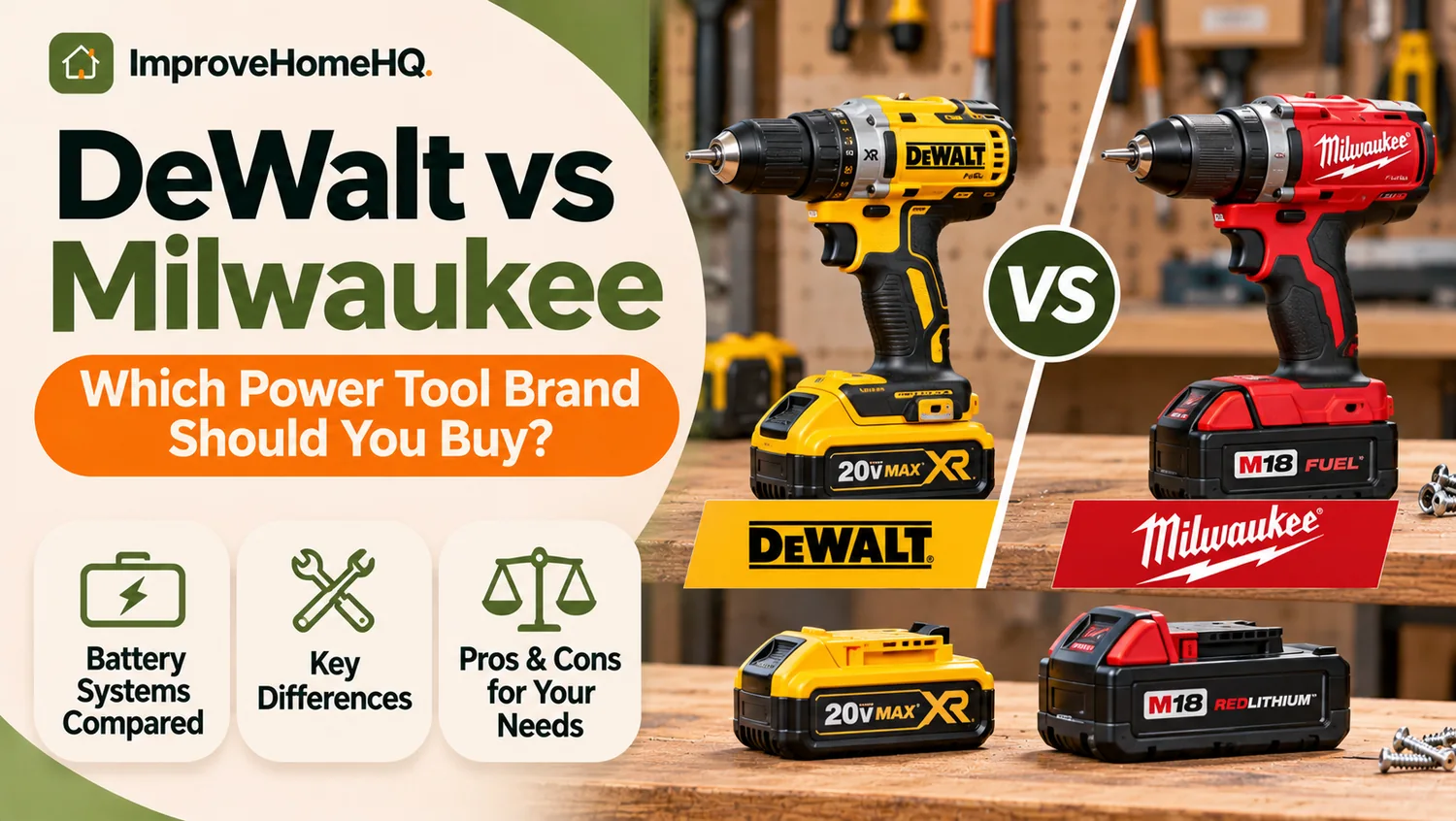
DeWalt vs Milwaukee: Which Power Tool Brand Should You Buy?
Quick answer: DeWalt and Milwaukee both make professional-grade power tools, and neither brand wins every category. DeWalt is a strong choice for carpentry, remodeling, and buyers who want access to its 20V MAX and FLEXVOLT systems. Milwaukee is particularly appealing for electricians, plumbers, mechanics, and anyone who benefits from its compact M12 and extensive M18 lines. For most buyers, the best choice is the brand that makes the next five tools they’ll actually use—not whichever drill wins one test.
Choosing a cordless drill seems simple until you realize you’re also choosing batteries, chargers, saws, impact wrenches, lights, and potentially hundreds of dollars in future purchases. That’s why a brand comparison should go beyond color, reputation, and a single advertised torque number.
Both manufacturers sell capable DIY and professional equipment. Their strengths overlap heavily, but their battery families, specialty tools, handling, and storage systems create meaningful differences. Here’s how to decide without paying for features you won’t use.
DeWalt vs Milwaukee at a Glance
| Category | DeWalt | Milwaukee |
|---|---|---|
| Core full-size cordless line | 20V MAX (18V nominal) | M18 (18V nominal) |
| Compact cordless line | 12V MAX (10.8V nominal) | M12 (12V class) |
| High-demand cordless option | FLEXVOLT 20V/60V MAX | M18 FUEL tools and high-output/FORGE batteries; MX FUEL for separate equipment platform |
| Standout use cases | General construction, carpentry, remodeling, cordless saws | Electrical, plumbing, HVAC, automotive service, compact access |
| Premium technology names | XR, POWERSTACK, FLEXVOLT, FLEXVOLT ADVANTAGE | FUEL, REDLITHIUM HIGH OUTPUT, FORGE |
| Modular storage | TOUGHSYSTEM, TSTAK | PACKOUT |
| Tool tracking on select products | TOOL CONNECT | ONE-KEY |
| Typical limited warranty on many cordless power tools | Three years, with additional service/return benefits on qualifying products | Five years on many portable power tools, with exceptions |
| Best deciding factor | Specific tool selection and battery investment | Specific tool selection and battery investment |
Important: These are product-family distinctions, not a claim that every DeWalt saw beats every Milwaukee saw—or that every Milwaukee impact wrench outperforms DeWalt’s equivalent.
Are DeWalt and Milwaukee the Same Quality?
Both brands operate in the professional power-tool market and offer brushless motors, electronic protection systems, metal gearing on many models, and tools designed for regular jobsite use. However, product quality varies by model and tier.
An entry-level brushed drill should not be compared directly with a premium brushless hammer drill. Even within one brand, weight, chuck quality, controls, vibration, and serviceability may vary substantially.
DeWalt is part of Stanley Black & Decker, while Milwaukee Tool belongs to Techtronic Industries. Ownership alone says little about which individual tool is better. The more useful questions are whether the exact model suits your work, whether it fits comfortably, and whether replacement batteries and service are readily available.
Bottom line: Brand reputation is a starting point. Model-specific performance and ownership costs should make the decision.
Battery Systems: The Most Important Difference
DeWalt 20V MAX vs Milwaukee M18: Is 20V More Powerful Than 18V?
No. DeWalt’s 20V MAX name refers to maximum initial battery voltage measured without a workload. DeWalt specifies 18V nominal for that system. Milwaukee’s M18 is also an 18V-class platform. The labels do not establish a performance advantage.
Real cutting or drilling performance depends on the motor, electronics, gearing, thermal limits, battery output, and accessory being used. Comparing two tools just by the voltage printed on the housing is misleading.
DeWalt Battery Options
DeWalt’s main cordless choices include:
- 20V MAX: Its broad everyday platform for drills, drivers, saws, sanders, nailers, and more.
- XR: A performance-oriented label appearing on selected tools and batteries, not a separate incompatible voltage platform.
- POWERSTACK: Selected compact, pouch-cell battery packs designed to deliver higher output in certain applications.
- FLEXVOLT: Batteries that automatically switch configuration when used with compatible 20V MAX or 60V MAX equipment. Select 120V MAX tools use two FLEXVOLT batteries.
- 12V MAX: A separate compact-tool battery family, not interchangeable with standard 20V MAX batteries.
A critical compatibility detail: a FLEXVOLT battery can power compatible 20V MAX tools, but an ordinary 20V MAX battery cannot power a 60V MAX FLEXVOLT tool. Also, FLEXVOLT ADVANTAGE tools are 20V MAX models designed to benefit from certain higher-output batteries; they are not the same thing as dedicated 60V tools.
Milwaukee M12, M18, and FORGE
Milwaukee splits its cordless lineup into distinct systems:
- M12: Compact tools favored for tight spaces, overhead work, service jobs, and smaller fasteners.
- M18: Its larger cordless platform covering drills, saws, impact wrenches, grinders, and other demanding applications.
- FUEL: A premium tool designation featuring brushless motor and electronic technologies; it is not a separate battery connection.
- REDLITHIUM HIGH OUTPUT and FORGE: Battery families engineered for demanding applications within compatible systems.
- MX FUEL: A separate platform for larger equipment, not an M18 battery upgrade.
Milwaukee confirms that M18 batteries fit M18 tools, including its FORGE batteries, and M12 batteries fit M12 tools. M12 and M18 batteries do not fit each other’s tools. Some Milwaukee chargers accept both battery formats, but that does not make the packs interchangeable.
Which Batteries Are Better?
Neither battery lineup has a universal advantage. Compare the particular battery and tool pairing.
For instance, a compact pack can make a drill comfortable for cabinet installation, but a larger pack may help a circular saw maintain output during repeated cuts. A high-output battery can make a noticeable difference on a tool designed to use that power; it does not magically turn every older drill into a newer premium model.
Battery buying tip: Check watt-hours when comparing usable stored energy across different voltages. Amp-hours alone can be misleading. At the same nominal voltage, higher amp-hours generally mean more stored energy, but actual runtime still depends on the task, tool efficiency, and load.
Head-to-Head Performance by Tool Type
Drills and Hammer Drills
Both brands sell excellent compact drills and high-performance hammer drills. On premium models, useful differences include how quickly they drill under load, how often electronic anti-kickback protection activates, the chuck’s grip, and the size of the tool.
For household work—installing shelves, assembling cabinets, or building a deck—either manufacturer’s well-chosen brushless drill can be more than sufficient. Heavy hole-saw drilling, large auger bits, and repeated masonry work deserve a closer model-to-model comparison.
Don’t confuse a hammer drill with a rotary hammer. Hammer drills handle occasional masonry holes, while a purpose-built SDS-plus rotary hammer is usually the better tool for frequent holes in concrete.
Which wins? No reliable brand-wide winner. Compare the exact drill models and battery packs, not the highest torque claim on the box.
Impact Drivers
Impact drivers excel at driving structural screws, lag screws, and other fasteners that can overwhelm a basic drill/driver. DeWalt and Milwaukee both offer compact brushless impact drivers with multiple drive modes.
For finish-sensitive work, look for a controlled low-speed setting and predictable trigger response rather than maximum torque alone. For deck framing or repeated construction fastening, ergonomics and sustained performance matter more than a difference in headline specifications.
A regular impact driver uses a 1/4-inch hex collet. An impact wrench uses a square drive and is usually the better choice for lug nuts and larger sockets.
Impact Wrenches and Automotive Tools
Milwaukee is especially compelling for automotive technicians because its M12 lineup includes compact ratchets and installation-friendly tools, while M18 covers a wide range of higher-output impact wrenches. A mechanic can build a complementary system around small under-hood tools and larger wheel or suspension tools.
DeWalt also offers powerful cordless impact wrenches, ratchets, and automotive tools. Its lineup should not be dismissed simply because Milwaukee is common in repair shops.
When comparing impact wrenches, distinguish fastening torque from nut-busting or breakaway torque. Neither number by itself guarantees success on a rusted bolt. Socket quality, battery condition, tool size, and working clearance also matter. Use a torque wrench to tighten critical fasteners to the vehicle manufacturer’s specification; an impact wrench isn’t a substitute.
Circular Saws, Miter Saws, and Woodworking
DeWalt is a particularly natural shortlist choice for general carpentry and remodeling, with a broad collection of circular saws, miter saws, and woodworking equipment. Its 20V MAX and 60V MAX options allow buyers to match lighter everyday work with more demanding cutting applications.
Milwaukee also makes serious cordless saws, including M18 FUEL circular, reciprocating, and miter saw models. The right pick depends on blade orientation, depth of cut, visibility of the cut line, balance, dust collection, and whether the battery you already own can support sustained cutting.
If you work primarily in a stationary shop, a corded table saw or miter saw may make more sense than committing to an expensive cordless solution. Battery convenience is valuable, but it isn’t automatically worth the cost for every workspace.
Reciprocating Saws, Grinders, and Specialty Tools
Both brands offer capable reciprocating saws and grinders for demolition and metalwork. The differences that matter include vibration, guard adjustment, weight, braking, and performance with the appropriate accessory.
Milwaukee has a particularly broad reputation for trade-focused products such as press tools, cable tools, inspection equipment, and specialty plumbing or electrical equipment. DeWalt also serves these trades; verify that the exact specialized tool you need exists in your preferred battery platform before investing heavily.
A professional plumber who needs a specific press tool should make that purchase requirement central to the decision. A homeowner who needs a drill and circular saw probably shouldn’t prioritize a specialty tool they will never use.
DeWalt vs Milwaukee for Different Users
| Your main work | Better starting shortlist | Why |
|---|---|---|
| Occasional household repairs | Either brand | A well-priced brushless combo kit is usually more important than brand |
| Decking, framing, and remodeling | DeWalt or Milwaukee M18 | Compare specific saws, drivers, and battery kits |
| Cabinetmaking and woodworking | DeWalt worth a close look | Extensive general carpentry and cutting options |
| Electrical work | Milwaukee M12/M18 worth a close look | Compact access and numerous trade-focused choices |
| Plumbing and HVAC | Milwaukee M12/M18 worth a close look | Strong selection of service and specialty tools |
| Automotive repair | Milwaukee worth a close look | Compact ratchets and broad impact-wrench choices |
| Existing substantial battery collection | Usually stay with your current brand | Avoid buying redundant chargers and batteries |
These are buying shortcuts, not rankings from a controlled test. A particular DeWalt model can be the better tool for a specific electrical or automotive task, and a particular Milwaukee saw can be the better woodworking purchase.
Price and Value: Which Brand Costs Less?
There is no dependable brand-wide answer. Prices change with promotions, kit configurations, retailers, battery capacities, and model generations. One brand’s drill-only price is not comparable to the other’s kit with two batteries and a charger.
Use this checklist before comparing sale tags:
- Match tool tiers. Compare brushless professional models with similar brushless professional models.
- Check every box item. Identify battery quantity, amp-hours, charger, case, and included accessories.
- Compare your next purchases. A cheap starter kit is less attractive if the saw or ratchet you need later costs far more.
- Account for spare batteries. A second pack often matters more than a slightly faster bare tool.
- Consider tool-only sales. Once you’ve committed to a battery system, bare tools can lower expansion costs.
A Practical Five-Tool Cost Comparison
Suppose your planned setup includes a drill, impact driver, circular saw, oscillating multi-tool, and work light. Instead of choosing the cheaper drill, price the complete setup using current retailer listings. Include two suitable batteries and a charger, then note which kits already supply those items.
You may discover that the more expensive starter kit produces the less expensive overall setup—or that one platform offers a tool you prefer enough to justify a modest premium. This approach is more reliable than an unsupported claim that either brand is always cheaper.
Warranty, Repairs, and Long-Term Reliability
DeWalt Warranty
Many qualifying DeWalt power tools include a three-year limited warranty, one-year free service contract, and 90-day money-back guarantee. These provisions cover different circumstances, and exclusions apply. Other product categories can have different coverage.
Milwaukee Warranty
Many Milwaukee portable power tools have a five-year limited warranty, subject to exceptions. Battery warranties vary by battery model and are not automatically five years. Normal wear, misuse, and certain other causes are excluded.
A longer headline warranty is helpful, but service availability, proof of purchase, exclusions, and whether a tool is repairable all matter. Before buying, consult the manufacturer’s terms for your exact model:
Reliability reality check: Online complaints can reveal recurring issues worth researching, but isolated stories of a dropped drill surviving—or a tool failing—don’t establish a measurable failure rate. Neither manufacturer publishes a simple, directly comparable failure-rate figure covering all its power tools.
Ergonomics, Storage, and Jobsite Convenience
Even an excellent tool can be frustrating if its handle doesn’t fit your hand or the battery blocks access to a fastener. If possible, handle both models at a retailer before deciding.
Check the balance with the battery installed. Try reaching into the kind of tight location you work in. Pay attention to trigger control, belt-hook placement, grip diameter, forward/reverse switch placement, and the view around the chuck or blade.
For storage, Milwaukee’s PACKOUT and DeWalt’s TOUGHSYSTEM are modular jobsite-focused systems. DeWalt also offers TSTAK. Compare box sizes, organizer layouts, rolling options, and how easily a stacked setup fits your vehicle. These storage platforms are not generally cross-compatible without additional third-party hardware.
For larger crews, DeWalt’s TOOL CONNECT and Milwaukee’s ONE-KEY provide tracking or inventory-related features on select compatible products. Don’t assume every tool has built-in location tracking; capabilities depend on the model and any required accessories.
Can You Mix DeWalt and Milwaukee Tools?
Yes. You can own and use both brands, and many professionals do. The trade-off is managing separate battery packs and chargers.
The batteries are not natively interchangeable between the two brands. Third-party adapters exist, but their fit does not guarantee proper electrical protection, charging safety, or warranty coverage. Use the batteries and chargers specified by the manufacturer, especially for high-current tools.
Mixing brands can still make sense if you already own one system and the other manufacturer offers a specialty tool that solves a real problem. Forcing every future purchase into one system is convenient, but not always cost-effective.
Common Mistakes When Choosing a Cordless Tool Brand
- Assuming 20V beats 18V: The nominal voltage comparison doesn’t support that conclusion.
- Buying for peak torque alone: Control, size, runtime, and actual work rate often matter more.
- Comparing mismatched kits: A bare tool and a two-battery kit have different total values.
- Ignoring the next five purchases: Batteries create long-term platform costs.
- Treating all batteries as interchangeable: M12, M18, 12V MAX, 20V MAX, and 60V MAX have different compatibility rules.
- Assuming one warranty covers everything: Tools and batteries often have different terms.
- Paying for maximum performance unnecessarily: A compact midrange tool may be more useful for routine home projects than a heavier top-tier model.
Which Brand Should You Choose? A Simple Decision Process
Start by listing the three tasks you do most often and the five tools you expect to buy during the next two years. Put any must-have specialty tool at the top of your list.
Next, check battery compatibility and price the complete setup, not just the first drill. Handle the two most-used tools if possible. Finally, confirm the warranty and authorized local service options for your intended models.
If the results are close, choose the kit that’s more comfortable or offers the better current value. Both platforms are capable enough for serious projects. And if you already have several working batteries, staying with that platform is often the simplest economic decision.
Frequently Asked Questions
Is Milwaukee better than DeWalt for professional use?
Not across the board. Milwaukee is especially attractive for professionals who rely on compact M12 tools or trade-specific equipment, while DeWalt is highly competitive for construction, carpentry, and remodeling. Compare the exact tools required for your trade.
Is DeWalt cheaper than Milwaukee?
Not consistently. Price depends on the product, kit contents, model generation, and promotions. Compare equivalent tools and the total cost of the battery platform you need.
Which brand has better batteries?
Both have advanced lithium-ion options. Milwaukee’s M18 HIGH OUTPUT and FORGE and DeWalt’s POWERSTACK and FLEXVOLT technologies address different needs. The best pack depends on tool compatibility, output requirements, runtime, weight, and price.
Do DeWalt batteries work on Milwaukee tools?
No, not directly. Their mounting interfaces and electronics are different. Avoid assuming third-party adapters preserve the manufacturer’s safety systems or warranty protection.
Is Milwaukee M18 stronger than DeWalt 20V MAX?
Not simply because of the platform name. Both are 18V nominal systems. Actual performance depends on the specific tool, battery, and application.
Is Milwaukee M12 enough for home use?
Often, yes. A compact M12 drill or driver can handle many assembly and light repair jobs. Larger holes, heavy framing, frequent cutting, or demanding fasteners may justify stepping up to M18 or DeWalt 20V MAX equipment.
Which lasts longer, DeWalt or Milwaukee?
There’s no credible universal lifespan figure that settles the question for every product. Tool quality, workload, maintenance, storage, and the specific model all influence service life. Look at model-specific testing, warranty terms, and parts availability.
Should beginners buy a combo kit?
A drill-and-impact-driver kit with two batteries and a charger can be a sensible starting point if you’ll use both tools. Avoid large combo kits padded with tools that don’t match your projects.
Final Verdict
The choice comes down to the tools you’ll use, the battery system you’ll expand, and the price of your complete setup—not a universal red-versus-yellow winner.
Choose DeWalt when its particular saws, drills, and carpentry-oriented options suit your work or you already own 20V MAX batteries. Choose Milwaukee when M12 compact tools, M18 specialty equipment, or its automotive and trade-focused options suit your needs better.
For a new homeowner buying only a drill and impact driver, either brand can be an excellent purchase. Compare equivalent brushless kits, prioritize comfort and battery value, and invest in the system that makes your next project easier.