Best Exterior Paint in 2026: Top Picks for Different Homes and Climates
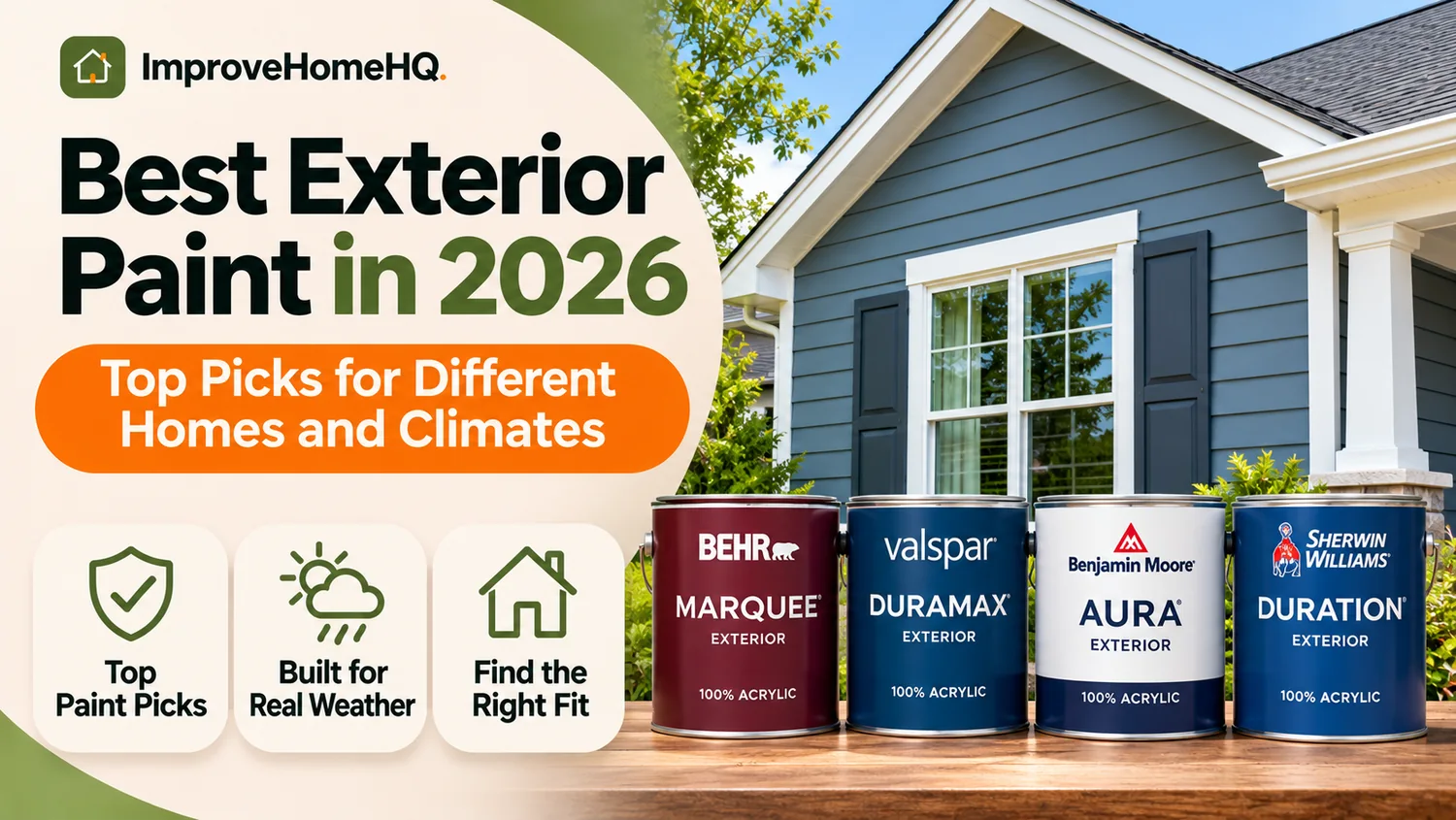
Quick answer: For a typical U.S. house with properly prepared siding, a quality 100% acrylic exterior paint is usually the most versatile choice. Behr Marquee Exterior is a strong overall pick based on independent long-term laboratory ratings; Valspar Duramax is a compelling alternative from Lowe’s. Consider Benjamin Moore Aura Exterior for rich colors, Sherwin-Williams Duration for weather-exposed repaints, and Sherwin-Williams Emerald Rain Refresh if dirt accumulation is a particular concern. The right product still depends on your siding, local weather, and surface preparation.
A good exterior paint job should do more than make a house look freshly painted. It needs to handle sunlight, wind-driven rain, temperature swings, and moisture moving through the wall—without peeling, blistering, or losing its color too quickly.
But a premium label doesn’t guarantee the right result. The coating that works on painted wood siding in Colorado may be a poor fit for damp stucco in Florida or a frequently used front porch. This guide compares notable exterior paints, explains where each makes sense, and helps you avoid the preparation and product-selection mistakes that shorten the life of a paint job.
Best Exterior Paint Picks at a Glance
| Paint | Best reason to consider it | Where it fits | Main caveat |
|---|---|---|---|
| Behr Marquee Exterior | Strong independent durability results | Properly prepared siding and trim | One-coat claims have strict limitations |
| Valspar Duramax Exterior | Strong test performance and Lowe’s availability | Whole-house repaints | Confirm the finish and substrate on the label |
| Behr Ultra Exterior | Practical middle-tier alternative | Budget-conscious siding projects | Not interchangeable with Marquee for every performance measure |
| Sherwin-Williams Duration Exterior | Flexible, high-build acrylic coating | Sound, previously painted exteriors | Self-priming doesn’t eliminate every primer need |
| Benjamin Moore Aura Exterior | Fade resistance and deep-color options | Color-focused siding and trim | Premium cost; substrate preparation remains essential |
| Sherwin-Williams Emerald Rain Refresh | Dirt-shedding technology | Walls prone to visible grime | Rain does not remove every stain or replace cleaning |
| PPG Permanizer Exterior | Interesting real-world exposure-test results | A candidate for regional comparison | One small field test isn’t a nationwide ranking |
How these picks were chosen: We considered independent published paint testing, manufacturer product information, suitability for common U.S. exterior surfaces, and the practical limits of marketing claims. These are editorial recommendations—not products we independently painted or field-tested. Different test methods can produce different rankings.
What Is the Best Exterior Paint for Most Homes?
For many homeowners, Behr Marquee Exterior and Valspar Duramax Exterior deserve to be on the shortlist. In Consumer Reports’ 2026 exterior paint ratings, Marquee scored 75 out of 100, Duramax scored 72, and Behr Ultra scored 69. The ratings evaluated how coatings looked after simulated exposure periods, including the equivalent of nine years. Those are laboratory projections, not a guarantee that your house will look the same after nine real-world years.
Paint adhesion, the condition of existing coatings, wall moisture, and correct application often matter more than the difference between two well-regarded products.
Here is how the leading options compare in practice.
1. Behr Marquee Exterior — Strong All-Around Choice
Marquee is a premium acrylic paint sold through Home Depot. Its appeal is a combination of good hiding, dirt and fade resistance, and consistently strong performance in published exposure testing.
Best for: Homeowners repainting sound, properly cleaned and prepared siding who want a durable, widely available product.
What stands out: Behr advertises one-coat hiding in a designated collection of colors, but there are important exclusions. The claim does not cover every tint or uncoated, porous, repaired, heavily stained, or tannin-rich surface. Behr also recommends two coats for optimal exterior durability.
Watch out for: Treating “paint and primer” as permission to skip sealing bare wood, spot-priming repairs, or addressing peeling paint. Those jobs still call for appropriate surface preparation and sometimes a separate primer.
2. Valspar Duramax Exterior — Excellent Alternative From Lowe’s
Duramax is an acrylic exterior paint positioned for weather resistance, and it performed well in independent published testing. It is a convenient option for people buying supplies at Lowe’s.
Best for: Homeowners comparing premium products for a full-house repaint, especially when local availability influences the choice.
What stands out: Its test performance makes it more than simply a lower-priced substitute for a specialty paint-store brand.
Watch out for: Assuming one product works on every horizontal and vertical surface. Siding paint and walk-on porch paint are different categories. Check the exact can’s approved substrates, temperature range, and recoat instructions before starting.
3. Behr Ultra Exterior — A Sensible Middle Ground
Behr Ultra is worth considering when Marquee stretches the budget. It performed well in published testing, although its simulated nine-year appearance was not identical to Marquee’s.
Best for: Large, properly prepared exterior walls where balancing initial cost and performance matters.
What stands out: It offers a credible alternative without automatically requiring the highest-priced line in a store.
Watch out for: Comparing only cost per gallon. A paint requiring additional coats or more frequent repairs can become more expensive over the life of the project.
4. Sherwin-Williams Duration Exterior — Strong for Repainting
Duration is a high-build acrylic exterior coating designed to form a relatively thick, flexible film. Sherwin-Williams emphasizes resistance to cracking, peeling, and blistering and allows application at temperatures as low as 35°F under specified conditions.
Best for: Previously painted siding where the old finish is generally sound and the homeowner wants a premium repaint system.
What stands out: Its film-building properties can be useful on weather-exposed facades, and its low-temperature capability provides some scheduling flexibility.
Watch out for: Mistaking high-build paint for a repair product. It cannot fix rotting boards, structural movement, active water leaks, or widespread adhesion failure. One-coat repaint claims also depend on the surface and product directions.
5. Benjamin Moore Aura Exterior — Ideal When Color Matters
Aura Exterior is a premium 100% acrylic line with Benjamin Moore’s Color Lock and Gennex technologies. The manufacturer highlights fade resistance, color depth, gloss retention, and application down to 35°F in eligible conditions.
Best for: Homes with saturated body colors, contrasting trim, or prominent architectural details where appearance and color retention are priorities.
What stands out: It is a worthwhile candidate when selecting a dark blue, deep green, or other bold color. The manufacturer also offers specific guidance for vinyl-safe colors.
Watch out for: Treating color-retention claims as proof that all dark shades perform equally. Exposure, tint formulation, sheen, and surface temperature can change the outcome. Verify that your selected color is approved for the siding material.
6. Sherwin-Williams Emerald Rain Refresh — Worth Considering for Dirt-Prone Walls
Emerald Rain Refresh is formulated to shed some surface dirt when contacted by rain or water. It also includes protection against UV exposure and weathering.
Best for: Houses near dusty roads, under trees, or in locations where exterior walls visibly collect grime.
What stands out: Its dirt-shedding feature targets a real maintenance frustration, particularly on light-colored exterior walls.
Watch out for: Expecting a self-cleaning coating to eliminate algae, embedded stains, or periodic washing. Rainfall patterns and the type of contamination affect results. It is also not automatically a better value than standard Emerald or Duration for every house.
7. PPG Permanizer — A Promising Regional Contender
Permanizer deserves attention because Paint Pals, a Colorado painting company, reported that it performed best in its three-year exposure experiment on painted boards. In that specific test, Behr Pro e600 was another surprise performer, placing ahead of several more expensive products.
Best for: Homeowners who want to compare options beyond the most familiar retail brands and can confirm a suitable local product and application system.
What stands out: The experiment is a useful reminder that price and brand prestige are not perfect predictors of performance.
Watch out for: Generalizing one Colorado test to every U.S. climate. Horizontal test boards experience different exposure from a vertical house wall, and a small field comparison is not the same as independent, standardized testing across multiple regions.
How to Choose Paint for Your Exterior Surface
The underlying material is usually the first decision—not the brand. Check the coating’s current technical data sheet before buying, since an exterior product may be approved for some substrates but not others.
| Surface | Usually suitable approach | What needs special attention |
|---|---|---|
| Painted wood siding | Quality 100% acrylic exterior paint | Remove failing paint; prime bare wood and stain-prone knots as directed |
| Cedar or redwood | Compatible stain or acrylic system with tannin-blocking primer | Extractive bleeding; existing stain compatibility |
| Fiber cement | Manufacturer-approved acrylic exterior coating | Cut edges, exposed areas, moisture issues, factory-finish requirements |
| Vinyl siding | Exterior coating specifically approved for vinyl | Dark colors can increase heat and cause warping |
| Aluminum siding | Compatible acrylic coating and suitable primer if needed | Oxidation, chalking, and adhesion |
| Stucco or brick | Masonry-approved breathable acrylic coating or appropriate masonry system | Moisture, efflorescence, alkalinity, and cracks |
| Exterior metal | Substrate-specific metal primer and compatible topcoat | Rust removal, corrosion protection, and existing finish |
| Deck or porch floor | Dedicated porch, floor, or deck coating | Foot traffic, traction, standing water, and abrasion |
Wood siding: Prioritize adhesion and moisture control
Wood expands and contracts as its moisture content changes. A flexible acrylic paint is often a good choice, but no topcoat can keep wet, rotting, or poorly sealed wood intact indefinitely.
Repair damaged boards, remove loose coatings, allow the surface to dry, and use a primer suited to the wood. Cedar and redwood may need a stain-blocking primer to keep tannins from discoloring the finish. If the wood is currently stained, confirm that switching to paint is appropriate and that the old finish can be prepared for adhesion.
Vinyl and aluminum: Check compatibility first
Vinyl can distort if a darker paint absorbs substantially more heat than its original color. Follow the siding maker’s instructions and use only approved vinyl-safe colors and coatings. Don’t assume that a paint labeled “exterior” is automatically safe for every vinyl panel.
On aluminum, remove chalky oxidation and use any bonding primer specified for the surface. Painting over loose oxidation is a common cause of early coating failure.
Stucco, brick, and concrete: Investigate moisture before paint
Masonry can hold and transmit moisture. Before painting, find the cause of white efflorescence, damp patches, peeling, or recurring cracks. A breathable, masonry-approved acrylic system may be appropriate for many sound walls.
Elastomeric coatings can bridge some small cracks when applied to the specified film thickness, but they are not a universal solution. The wrong coating system may complicate moisture escape. Follow the masonry and paint manufacturers’ guidance on curing, alkalinity, priming, and vapor permeability.
Porches, steps, and decks: Don’t use ordinary siding paint
Horizontal surfaces face standing water, shoe abrasion, furniture movement, and sometimes ice. Choose a coating explicitly rated for the floor or deck material and expected foot traffic. Consider slip resistance, especially on stairs and wet concrete.
Acrylic Latex vs. Oil-Based vs. Elastomeric Paint
100% acrylic latex is the default starting point for many residential exteriors. It cleans up with water, maintains flexibility, and is available in formulations for wood, fiber cement, and various masonry surfaces. “Latex” usually describes a water-based coating; it doesn’t necessarily contain natural rubber latex.
Oil-based or alkyd paints can still be useful for certain metalwork, doors, and specialty applications. However, they are not automatically better for siding, and local volatile organic compound (VOC) rules may restrict particular products. Use only a coating approved for the project and existing finish.
Elastomeric coatings are thicker systems often used on compatible stucco or masonry. They may help span minor, nonstructural hairline cracking, but achieving that benefit depends on the specified dry-film thickness and properly prepared surfaces. They do not replace crack repair or moisture diagnostics.
Which Exterior Paint Finish Should You Choose?
Sheen affects appearance, cleanability, and how much surface damage is visible.
| Finish | Common use | Main trade-off |
|---|---|---|
| Flat or matte | Older siding, textured masonry | Hides irregularities; can hold dirt more noticeably |
| Low-luster or satin | Most siding in sound condition | Good balance of appearance and cleaning |
| Semi-gloss | Doors, window trim, architectural details | Easier to wipe; highlights imperfections |
| Gloss | Selected doors and accent features | Reflective, dramatic look; needs careful preparation |
A satin or low-luster finish is often the safest stylistic choice for siding. Choose flat for heavily textured or imperfect surfaces when the product is appropriate. Reserve higher sheens for surfaces that benefit from washability and a sharper visual contrast.
Not every product offers every finish. Compare finishes within the same paint line rather than assuming a “satin” from one manufacturer looks identical to another.
What Makes Exterior Paint Last?
A long-lasting finish depends on more than marketing words such as “premium,” “lifetime,” or “one coat.” Pay attention to these five characteristics:
- Adhesion: The coating must bond to the existing surface rather than dirt, chalk, loose paint, or moisture.
- UV and color resistance: Sun exposure can fade pigments and break down binders, particularly on strongly exposed elevations.
- Flexibility and film integrity: The paint needs to tolerate normal substrate movement without widespread cracking or peeling.
- Moisture behavior: It should resist exterior rain while remaining appropriate for the way the wall assembly manages moisture.
- Mildew and dirt resistance: These features can keep the finish looking cleaner, but they cannot eliminate underlying moisture or biological growth.
Independent comparisons are helpful, yet even accelerated weathering tests cannot predict an exact repainting date for a particular house.
How long should exterior paint last?
A useful planning range for many well-prepared, painted exteriors is roughly 5–10 years, with some jobs lasting less or considerably longer. The actual interval depends on surface, climate, sun direction, prior coating condition, workmanship, and maintenance. Avoid treating “10 years” or a lifetime warranty as a performance promise.
Look for early signs of failure: widespread chalking, peeling around joints, bare wood, blistering, persistent staining, and cracks that expose the substrate. Inspect sunny elevations and areas around gutters and windows at least once a year.
Do You Need a Primer With Paint-and-Primer Products?
Sometimes yes. “Paint and primer in one” generally describes hiding and adhesion capabilities under specified conditions; it is not an all-purpose substitute for an actual primer.
Use a separate, compatible primer when the product instructions require it, especially for:
- Bare or weathered wood and exposed repairs
- Cedar and redwood with possible tannin bleed
- Rust-prone metal
- Chalky or glossy surfaces needing a specialty bonding system
- Masonry requiring an alkali-resistant or other specialized primer
- Stained patches or significant substrate changes
If the existing coating is tightly adhered, clean, dry, and compatible, a self-priming topcoat may be sufficient. Follow the exact manufacturer’s instructions for your substrate rather than relying on the front-of-can claim.
How Much Exterior Paint Do You Need?
Estimate the area of each wall, subtract large windows and doors, then adjust for the number of coats and the product’s stated spread rate. Rough wood, brick, and textured stucco can use considerably more paint than smooth siding.
Example: Suppose the paintable walls total 1,600 square feet. If your paint is rated to cover 350 square feet per gallon per coat, two coats require:
1,600 × 2 ÷ 350 = 9.14 gallons
Allowing a modest 10% margin gives approximately 10.1 gallons. Buying 11 gallons may be sensible depending on available container sizes, spray losses, and touch-up needs. Your actual requirements can be higher if the surface is porous or the manufacturer’s coverage range is lower.
Remember that paintable wall area is not the same as your home’s interior floor area. A 2,000-square-foot house does not necessarily have 2,000 square feet of paintable siding.
When Is the Best Time to Paint a House Exterior?
Choose a period when temperatures, surface moisture, humidity, and rain forecasts all satisfy the specific product’s instructions.
Many modern premium acrylic coatings permit application at 35°F, but that doesn’t mean every paint does—or that a 35°F day is automatically safe. Surface temperature can differ from air temperature, and temperatures may fall before the paint forms a proper film.
For better results:
- Check both the air and surface temperature requirements.
- Avoid painting damp siding or a wall heating rapidly in intense direct sun.
- Respect the paint’s rain-resistance and recoat windows; these are not always the same as “dry to touch.”
- Monitor overnight temperatures and dew formation.
- Follow label instructions for humidity, wind, and application method.
A brief weather opening may not provide enough time for washing, repair, priming, two coats, and adequate drying.
How to Get Better Results From Any Exterior Paint
An expensive coating applied over a failing surface can fail quickly. The prep process is where a large share of a durable result is earned.
Step 1: Inspect and fix the cause of damage
Look for leaking gutters, failed flashing, rotten boards, loose caulk, open joints, and persistent dampness. Repair water-entry problems before painting. Don’t simply coat over blistered paint or mold.
Step 2: Clean without damaging the siding
Remove dirt, mildew, chalk, and loose debris with a method appropriate for the substrate. Follow cleaner directions, protect landscaping, and rinse thoroughly. Aggressive pressure washing can drive water behind siding, damage soft wood, or strip fragile finishes.
Step 3: Remove loose paint and address hazards
Scrape and feather failing areas only using methods appropriate to the building’s age and materials. For homes built before 1978, disturbing paint can release hazardous lead dust. Review the EPA’s lead-safe renovation guidance for homeowners before sanding, scraping, or hiring a contractor. Paid contractors working on applicable pre-1978 housing generally must follow EPA or authorized-state lead-safe requirements.
If older cement siding may contain asbestos, do not sand or abrade it until the material has been assessed and a safe work plan established.
Step 4: Prime where required
Use stain-blocking, bonding, corrosion-resistant, or masonry primers as appropriate. Allow the primer to dry according to its label before topcoating.
Step 5: Apply the correct film thickness
Do not stretch a gallon well beyond its rated coverage to save money. A thin coat may hide color initially but provide less protection. Follow the manufacturer’s specified wet-film or dry-film thickness, number of coats, and spread rate.
Step 6: Protect the finished job
Inspect seams and flashing, keep sprinklers off the walls while the coating cures, and maintain gutters and nearby vegetation. Wash dirt gently using the coating manufacturer’s recommended method.
Common Buying Mistakes That Cost More Later
Buying based on brand alone. The same manufacturer may sell products formulated for different substrates and budgets. Compare the actual product line and technical data.
Assuming one coat is enough. Hide and long-term film durability are different things. One-coat claims usually have color and surface restrictions.
Painting over unresolved moisture. This can lead to blistering and peeling no matter how expensive the paint is.
Using wall paint on a deck. Horizontal traffic surfaces require a coating designed for abrasion and standing water.
Selecting a dark color for vinyl without checking approval. Excess heat absorption can deform some siding.
Judging lifetime cost by shelf price. Labor, preparation, number of coats, and maintenance frequency may dominate the total expense.
Trusting warranties without reading them. Exclusions, transfer rules, proof-of-purchase requirements, and coverage limits can matter more than the large number printed on the can.
Frequently Asked Questions
What exterior paint do professional painters use?
Professional painters use a variety of brands, including Sherwin-Williams, Benjamin Moore, Behr, Valspar, and PPG. Their choice depends on substrate, local availability, coating specifications, budget, and familiarity with a paint system. Ask a contractor for the exact product line, primer, number of coats, and preparation details—not just the brand name.
Is Sherwin-Williams better than Behr for outdoor paint?
Neither brand is uniformly superior. Behr Marquee performed particularly well in the referenced independent testing, while Sherwin-Williams offers strong premium lines such as Duration and Emerald for different needs. A suitable product applied correctly will generally beat an incompatible premium coating.
Is 100% acrylic exterior paint better than latex?
Many 100% acrylic exterior paints are latex paints: latex commonly refers to water-based paint. The more useful distinction is the binder formulation, the product’s intended substrates, and its verified performance—not “acrylic versus latex” as though they are mutually exclusive.
What is the longest-lasting paint for a house exterior?
There is no reliable single winner for every house. A high-quality acrylic coating with the correct primer, proper thickness, and thorough surface preparation is a strong choice for many homes. For specialized masonry or other materials, a different approved coating system may be appropriate. Warranties do not establish an exact lifespan.
Should you use flat or satin paint outside?
Satin or low-luster is a versatile option for sound siding because it balances appearance and cleanability. Flat hides uneven surfaces better and often suits textured masonry. The best finish also depends on the specific product and how visible surface imperfections are.
Can you paint over old exterior paint?
Yes, if the old finish is compatible, well bonded, clean, and dry. Remove failing areas and prime as directed. Don’t paint directly over powdery chalk, loose layers, or active moisture damage.
Do two coats of exterior paint last longer than one?
Two properly applied coats often provide a more uniform protective film and better color coverage, particularly where manufacturers recommend them. More paint isn’t always better: excessive film thickness and improper recoat timing can cause problems too. Follow the product’s coating-system instructions.
What exterior paint works best in hot or rainy climates?
For strong sun, prioritize UV and fade resistance and approved colors for heat-sensitive siding. For wet or humid regions, prioritize proper drainage, moisture-compatible coatings, and resistance to mildew on the paint film. Match the product to the actual surface and local conditions rather than buying a paint advertised as “all-weather” without checking its limitations.
Final Verdict
For most homeowners comparing widely available house paints in 2026, Behr Marquee Exterior and Valspar Duramax Exterior offer an evidence-based starting point. Behr Ultra is worth examining when price matters, while Benjamin Moore Aura, Sherwin-Williams Duration, and Emerald Rain Refresh address particular priorities such as rich color, flexible repaint performance, or visible dirt.
The best purchase is the one that matches your siding, exposure, and preparation plan. Before you buy, confirm that the exact product is approved for the surface, choose the right sheen and primer, check the local forecast, and budget for enough paint to achieve the specified coverage. Those decisions do more for a lasting finish than picking a winner by brand reputation alone.