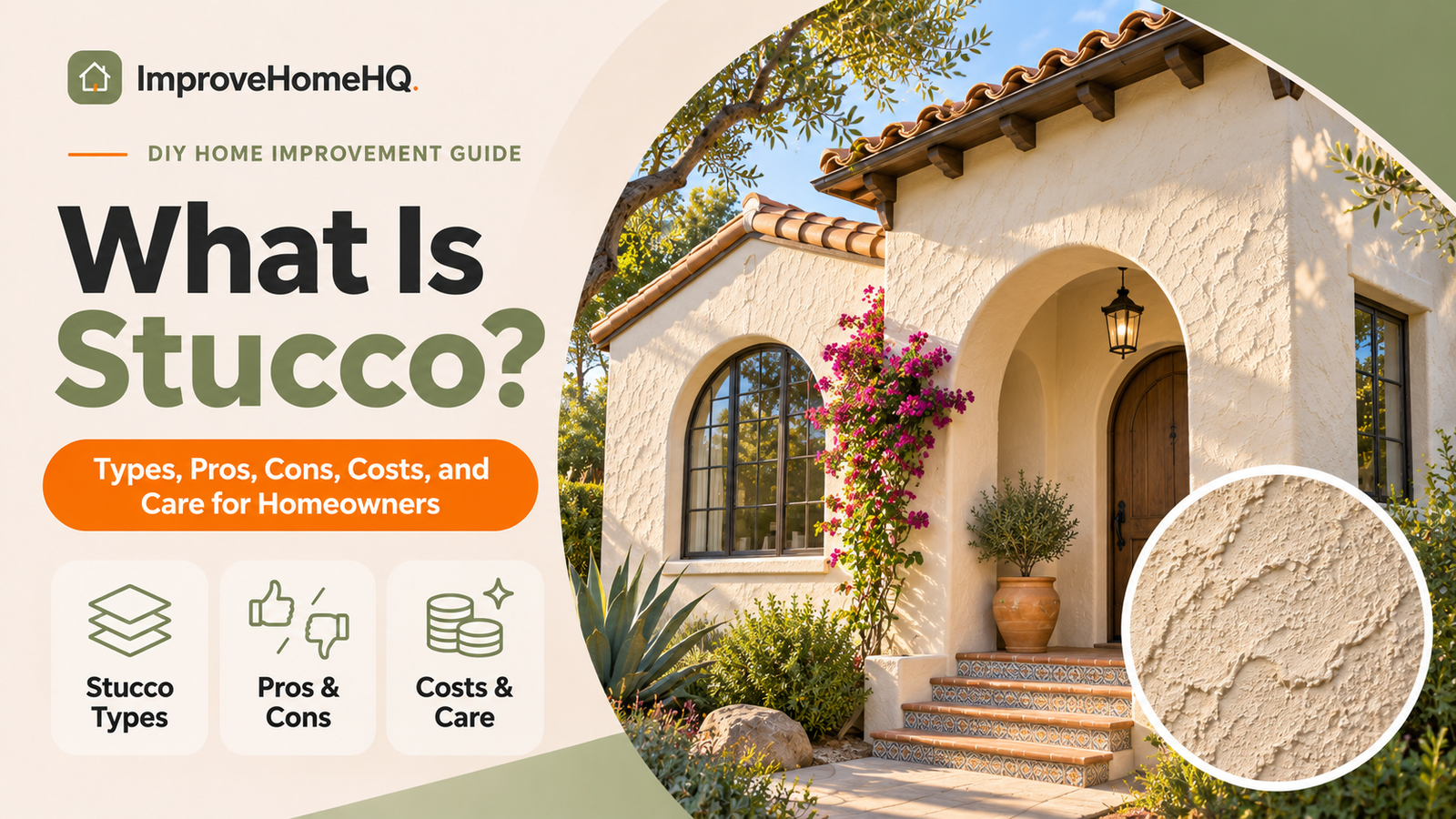
What Is Stucco? Types, Pros, Cons, Costs, and Care for Homeowners
Quick answer: Stucco is a plaster-like wall finish made primarily from cement, sand, water, and often lime. Applied wet and allowed to harden, traditional stucco creates a durable, textured or smooth exterior surface. It’s especially familiar on homes in the American Southwest, but it can work in other climates when the wall is designed to drain water properly. Common options include traditional three-coat stucco, proprietary one-coat systems, and stucco-look exterior insulation and finish systems (EIFS).
Stucco gives a home that continuous, sculpted exterior you see on Spanish Colonial houses, Mediterranean-style buildings, and many modern homes. It can be smooth and crisp or rough and rustic. But the finish is more than a design choice: the layers underneath determine how well the wall handles rain, movement, and decades of use.
If you’re comparing siding materials, replacing an aging exterior, or trying to understand the walls on a house you own, here’s what matters before you choose it.
What Is Stucco Made Of?
Traditional stucco is a type of Portland cement plaster. Its main ingredients are:
- Cement: The binder that helps the mixture harden into a solid surface.
- Sand: The aggregate that gives the plaster body and contributes to its texture.
- Water: Makes the mixture workable and supports cement hydration as it cures.
- Lime: Often added to improve workability; exact formulations vary.
- Optional pigments and additives: Provide color or alter specific performance characteristics.
Unlike a poured concrete wall, stucco is a relatively thin finish placed over a supporting wall or approved backing. It isn’t a replacement for the wall’s framing, sheathing, insulation, or moisture-management system.
According to the American Cement Association, Portland cement plaster can be installed over metal lath on framed walls or applied directly to suitable concrete and masonry surfaces. Installation details vary by substrate and system.
How Does a Stucco Wall Work?
On a typical wood-framed house, the visible plaster is only the outermost part of an assembly. Beneath it, a properly designed system may include wall sheathing, a water-resistive barrier (WRB), drainage provisions, flashing, metal lath, and the plaster coats themselves.
The stucco sheds much of the weather, while the concealed water-management layers handle water that gets past it. That’s critical because cement stucco is water-resistant, not waterproof. It can absorb rainwater, and small cracks or joints may allow moisture behind the finish.
The U.S. Department of Energy’s Building Science Education guidance on drainage planes recommends continuous drainage protection integrated with window, door, and wall flashings, plus an additional bond-break/drainage layer behind stucco assemblies. Exact requirements depend on the applicable building code and approved wall design.
What homeowners should look for: Don’t judge a stucco installation by its surface texture alone. Ask the contractor how the WRB, flashing, drainage, weep screed, and wall penetrations will work together.
Main Types of Stucco
The word stucco gets used for several finishes that look similar but aren’t built the same way.
| System | What it is | Main consideration |
|---|---|---|
| Traditional three-coat stucco | Cement plaster applied in scratch, brown, and finish coats, commonly over metal lath on framed walls | Durable, but relatively labor-intensive and rigid |
| One-coat stucco | A proprietary cementitious base-coat system, usually followed by a separate finish coat | Faster application; follow the manufacturer’s tested assembly |
| EIFS (often called synthetic stucco) | An exterior insulation and finish system using insulation board, reinforced base coat, and finish | Provides continuous exterior insulation; drainage and flashing details are essential |
| Acrylic finish | A polymer-based finish that may be used over compatible cementitious or EIFS base coats | A finish material, not necessarily a separate complete wall system |
Traditional Three-Coat Stucco
This is the familiar hard-coat material used on many older and newer homes. On framed walls, the installer applies a scratch coat, a leveling brown coat, and a decorative finish coat. A conventional three-coat assembly over lath is commonly about 7/8 inch thick, though approved designs and substrates can differ.
It creates a hard, impact-resistant surface with numerous color and texture options. Because the material is rigid, building movement and poor detailing can lead to cracking.
One-Coat Stucco
The name is slightly misleading. A typical one-coat system combines the traditional scratch and brown functions into a proprietary base coat, then receives a separate decorative finish. Some approved assemblies include foam insulation.
One-coat products aren’t interchangeable with every traditional mix. Thickness, lath, backing, curing, and installation details must match the product’s evaluation report and manufacturer instructions.
Synthetic Stucco and EIFS
Exterior Insulation and Finish System (EIFS) looks like stucco but works differently. Its assembly generally includes an insulation board—often expanded polystyrene (EPS)—a reinforced base coat with fiberglass mesh, and a thin finish coat.
The insulation can reduce thermal bridging through wall framing. However, insulation performance depends on the whole wall, not the finish alone. Modern drainage EIFS assemblies are designed to manage incidental water; older barrier-style installations without adequate drainage have been associated with serious concealed moisture damage.
If you’re buying a house with a stucco-looking exterior, ask whether it is hard-coat stucco or EIFS. The distinction affects inspection methods, repairs, and contractor selection.
What Does Stucco Look Like? Common Finishes and Colors
An installer can alter the appearance by changing the aggregate, tools, and finishing technique. Popular finishes include:
- Sand or float finish: A fine, even granular surface that works with many home styles.
- Dash finish: A coarser, sprayed or thrown texture with a pronounced profile.
- Skip-trowel finish: An intentionally irregular, hand-worked texture.
- Smooth finish: A clean contemporary appearance that requires skill and can make imperfections more visible.
- Lace or Spanish-lace finish: Raised, irregular patterns often seen on Southwestern and Mediterranean-style houses.
Color can be mixed into a compatible finish coat or applied later with an appropriate exterior coating. Integral color can make small surface scuffs less obvious, but weathering and patching may still create visible differences. Dark colors can increase solar heating and may require special consideration with certain insulated systems.
Practical tip: Ask to see a full-size sample panel in outdoor light. A small color chip won’t show how a rough texture casts shadows or how the finish will appear across an entire wall.
Pros and Cons of Stucco Siding
Advantages
Long service life. Well-installed cement plaster can perform for many decades. Its longevity depends heavily on moisture control, substrate movement, exposure, and maintenance—not just the plaster recipe.
Strong architectural appeal. A continuous finish suits Southwest, Spanish Revival, Mediterranean, contemporary, and minimalist designs. It also accommodates curves and decorative details.
Fire- and pest-resistant material. Cement-based plaster is noncombustible and doesn’t provide food for termites. That doesn’t make the entire wall fireproof or pestproof; framing, openings, insulation, and assembly ratings still matter.
Low routine upkeep. Sound exterior stucco typically needs periodic inspection and gentle cleaning rather than frequent refinishing.
Flexible appearance. Texture and color can be tailored to the home’s architectural style.
Disadvantages
Cracks can develop. Normal curing shrinkage, thermal movement, settlement, and improper control joints can produce cracks. Not every hairline crack signals structural failure, but widening or recurrent cracks deserve investigation.
Water damage can remain hidden. Failed sealant, missing flashing, or poor drainage can wet sheathing and framing behind an exterior that still looks mostly intact.
Installation requires skill. Preparation, mixing, coating thickness, curing, weather conditions, and details around openings all affect performance. Large jobs are rarely beginner-friendly DIY projects.
Repairs may show. Matching existing color and texture—especially weathered surfaces—can be difficult.
Weight and rigidity matter. The substrate and attachment system must be suitable for the planned cladding, and movement joints cannot simply be omitted to create a seamless look.
Is Stucco Good for Your Climate?
Stucco is often associated with dry Southwestern states such as Arizona, New Mexico, Nevada, and parts of California. In those regions, its appearance and durability make it a familiar choice. But climate alone doesn’t determine success.
Hot, dry climates: Cement stucco tolerates intense sun well. Still, the wall’s insulation, air sealing, and windows are far more important to indoor comfort than a thin plaster layer by itself.
Rainy or humid climates: A properly detailed drainage plane, compatible WRB, flashings, and drying potential become especially important. A finish advertised as “waterproof” isn’t a substitute for those components.
Cold or freeze-thaw climates: Saturated plaster can deteriorate when water freezes and expands. Good drainage, sound coatings, and prompt attention to leakage are important. Ask about regionally appropriate wall assemblies.
Coastal locations: Wind-driven rain, salt exposure, and corrosion-resistant metal accessories need attention. The right system should be selected for the actual exposure, not just the look you want.
A useful rule: A well-drained wall in a wet climate can be a better choice than a poorly detailed wall in a dry one.
How Is Stucco Applied to a House?
Details vary by product and wall construction, but a conventional three-coat installation over framed walls follows this general sequence.
1. Prepare the Wall and Water-Management Layers
The crew checks the sheathing and framing, installs the specified WRB and drainage or bond-break layers, and integrates flashing at windows, doors, roof intersections, and penetrations. Base-of-wall drainage components, including a weep screed where required, give water a path out.
2. Install Lath and Accessories
Metal lath supports the plaster on framed substrates. The installer also fits specified corners, casing beads, and control or expansion joints. Lath attachment and joint placement must follow the applicable standard and approved design.
3. Apply the Scratch Coat
The first cement plaster coat is pressed into the lath and roughened to give the next coat a mechanical key. It needs appropriate protection and curing before additional work.
4. Apply the Brown Coat
The brown coat builds thickness and establishes a reasonably even plane. The contractor levels it and follows the curing schedule required for the materials and job conditions.
5. Add the Finish Coat
The final coat provides the selected color and texture. Some jobs use an integral-color cement finish; others use a compatible acrylic finish or a later coating system.
How long does installation take? Expect the schedule to depend on the house size, access, number of coats, weather, curing requirements, and finish. Cement plaster needs controlled curing; rushing from one stage to the next can compromise the work. A fixed number of days is not reliable for every project.
Can you install it yourself? Small cosmetic patches may be reasonable for experienced DIYers. A complete exterior involves ladders or scaffolding, cement exposure, moisture detailing, and building-code requirements. For whole-house work, a qualified plastering contractor is the safer choice.
How Much Does Stucco Cost?
For preliminary budgeting in the United States, professionally installed traditional stucco is often quoted around 6–10 per square foot of wall area, but local bids can land outside that range. Specialty finishes, complicated elevations, removal of old siding, repairs to sheathing, and insulated systems can cost significantly more.
For example, at an illustrative 6–10 per square foot:
| Exterior wall area | Illustrative installed range |
|---|---|
| 1,000 sq. ft. | 6,000–10,000 |
| 1,500 sq. ft. | 9,000–15,000 |
| 2,000 sq. ft. | 12,000–20,000 |
These are planning examples, not contractor quotes. Wall area isn’t the same as the home’s floor area, and the figures don’t necessarily include demolition, major repairs, insulation changes, permits, or complex access.
What Changes the Price?
- System choice: Three-coat, proprietary one-coat, and drainage EIFS use different materials and labor.
- Existing wall condition: Rotten sheathing, failed flashing, or structural movement must be addressed before covering the wall.
- Architecture: Second stories, curves, many corners, and tight access add labor.
- Finish: Smooth, highly uniform work can require more skill than a forgiving texture.
- Location: Labor rates, weather windows, permit rules, and local demand vary.
When comparing estimates, ask each contractor to specify the wall assembly, brand or product system, moisture details, surface preparation, finish, cleanup, warranty, and exclusions. The cheapest bid can be expensive if it omits drainage or flashing work.
Stucco vs. Other Exterior Siding
| Material | Main advantage | Main trade-off |
|---|---|---|
| Stucco | Continuous, customizable masonry-like appearance | Cracking and moisture detailing need attention |
| Vinyl siding | Often lower upfront cost and easy replacement of individual panels | Different appearance and thermal movement |
| Fiber-cement siding | Familiar lap-board or panel styles and durable finish options | Requires proper cutting, clearances, and coating maintenance |
| Brick veneer | Traditional masonry appearance and high durability | Heavier, typically more expensive construction |
| Wood siding | Natural appearance and straightforward localized repairs | More frequent coating and moisture-related upkeep |
There isn’t a universal winner. Choose based on architecture, local installation expertise, wall design, expected upkeep, and your budget—not a single lifespan or price claim.
How to Maintain Stucco and Spot Problems Early
A short annual inspection can prevent a small defect from becoming a costly wall repair. Walk around your home after major storms and look especially closely below windows, beneath roof intersections, and near the ground.
Routine Care
- Inspect cracks and joints. Look for new openings, separated trim, and deteriorating sealant around penetrations.
- Watch for water clues. Persistent dark spots, staining, bubbling coatings, soft interior drywall, and musty odors can justify a closer inspection.
- Clean gently. Rinse loose dirt with a garden hose and use a soft brush with mild soap when needed. Avoid directing high-pressure water into the finish or around windows.
- Manage runoff. Keep gutters and downspouts working, prevent sprinklers from soaking the wall, and maintain required ground clearances.
- Use compatible products. Paints, patch mixes, and sealants should suit the existing cement or EIFS system and its drying characteristics.
Avoid a common mistake: Applying a blanket waterproof sealer without knowing the wall assembly. The wrong coating may interfere with drying or create new problems. Fix the water source first and follow the system manufacturer’s guidance.
When Should You Repair a Crack?
A stable, very fine surface crack may need monitoring or a compatible cosmetic repair. A widening crack, diagonal crack near an opening, repeated cracking after patching, bulging, loose material, or staining calls for professional evaluation. Crack width alone doesn’t tell you whether the issue is cosmetic, moisture-related, or structural.
Small damaged areas can often be patched after the cause is corrected. Widespread delamination, wet sheathing, or failed flashings may require removing sections of finish to repair the underlying wall. Simply painting over a leak doesn’t solve it.
If your house has EIFS, use a contractor who understands that specific system. Hard-coat plaster repair methods and EIFS repair methods are not interchangeable.
Common Mistakes to Avoid Before Choosing Stucco
Assuming the finish is the waterproofing. The drainage plane and flashing behind the finish are fundamental parts of the system.
Confusing hard-coat stucco with EIFS. They may look alike, but their construction, insulation, and repair procedures differ.
Ignoring movement joints. Properly placed joints help manage stress; decorative preferences should not override technical requirements.
Comparing prices by house floor area. Contractors generally need measured exterior wall area and the condition of the existing surfaces.
Using the wrong cleaning or patch product. High-pressure washing and incompatible coatings can damage an otherwise serviceable wall.
Hiring based only on a sample texture. Ask for local project references, insurance information, and a written description of the complete assembly—not merely the final color.
Frequently Asked Questions
Is stucco the same as plaster?
Stucco is a type of plaster, but the term usually refers to a cement-based exterior wall finish in U.S. residential construction. Interior plaster can use different formulations, including gypsum or lime, and is designed for different conditions.
Is stucco waterproof?
No. Traditional stucco resists weather but can absorb and transmit moisture. Properly designed walls use water-resistive barriers, drainage, and flashing to control rainwater that passes the outer finish.
How long does stucco last?
Properly installed and maintained cement stucco can last many decades, potentially 50 years or more. Service life varies with climate, workmanship, wall movement, moisture exposure, and maintenance. There is no guaranteed lifespan for every house.
Can stucco be painted?
Yes. Once the surface is sound, clean, and sufficiently cured, it can be painted with a coating compatible with the specific stucco assembly. Follow the coating manufacturer’s preparation and moisture requirements; painting will not repair underlying water damage.
Does stucco insulate a house?
The thin cement plaster layer provides limited thermal resistance by itself. An EIFS assembly can add meaningful exterior insulation because it includes foam board. For either system, total energy performance depends on the insulation, airtightness, windows, and full wall design.
Can stucco go over brick or concrete?
It can be applied over suitable masonry or concrete when the substrate is sound and properly prepared. Surface condition, coatings, bonding requirements, and the selected plaster system determine the method. Applying stucco over existing wood or vinyl siding without an approved assembly is not a safe shortcut.
Does stucco crack easily?
Fine cracking can occur because cement plaster is rigid and buildings move slightly. Good substrate preparation, curing, lath, reinforcement, and movement-joint detailing reduce problems, but no cementitious finish is completely crack-proof.
Is stucco expensive to maintain?
Routine cleaning and inspection are usually modest. Costs rise when water intrusion, poorly installed flashing, significant cracking, or extensive concealed damage must be corrected. Early investigation typically offers more options than waiting for visible deterioration.
Is Stucco Right for Your Home?
Stucco makes sense when you want a solid, continuous exterior with flexible color and texture choices—and when a qualified installer can provide a properly detailed wall assembly. It may be less appealing if you’re looking for easy panel-by-panel replacement or if your budget cannot accommodate correcting existing moisture or substrate problems.
The most valuable question isn’t simply how the finished wall will look. It’s how the wall will shed, drain, and dry after a hard rain. Get that part right, choose a finish you enjoy, and commit to periodic inspections. That’s the foundation of a stucco exterior that looks good and performs well for years.