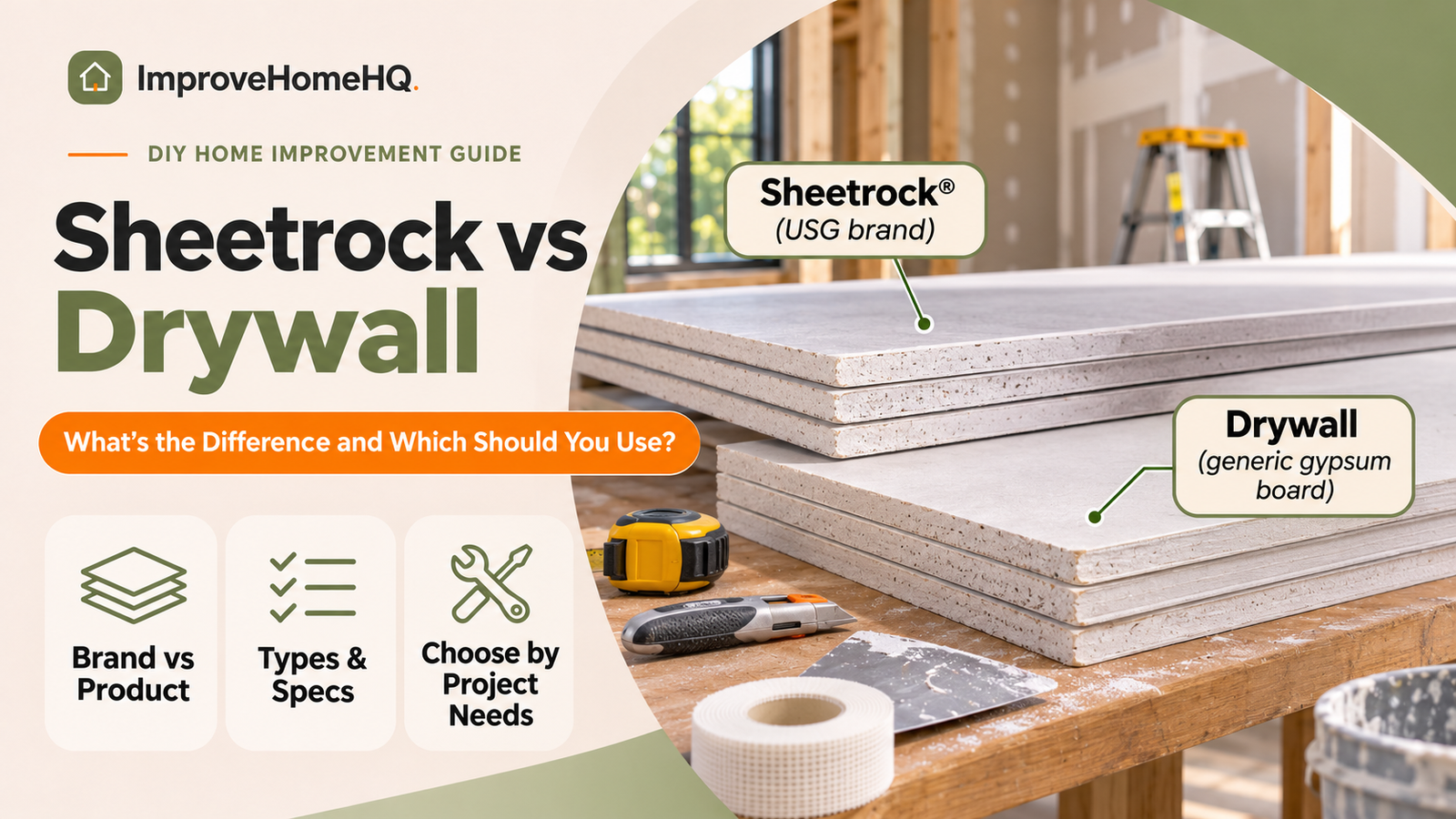
Sheetrock vs Drywall: What’s the Difference and Which Should You Use?
Quick answer: Sheetrock is a brand of drywall made by USG (United States Gypsum Company). Drywall is the general name for gypsum panels used to finish interior walls and ceilings. Both can serve the same purposes when their specifications match. The better choice depends on the panel’s thickness, fire and moisture performance, intended location, and price—not simply whether the label says Sheetrock.
If a contractor recommends Sheetrock but a home improvement store sells drywall, you don’t need to buy two different materials. The terms are often used interchangeably because Sheetrock is one of the best-known drywall brands.
There are differences worth checking before you purchase, though. A standard panel from one manufacturer isn’t necessarily equivalent to a specialty panel from another. Here’s how to compare them without paying extra for features you don’t need—or overlooking ones your project requires.
Sheetrock vs Drywall: Key Differences at a Glance
| Feature | Drywall | Sheetrock |
|---|---|---|
| What it means | General category of gypsum wallboard | USG’s branded line of gypsum panels |
| Manufacturer | USG, National Gypsum, Georgia-Pacific, CertainTeed, American Gypsum, and others | USG |
| Basic construction | Typically a gypsum core between paper facings | Typically a gypsum core between paper facings |
| Common uses | Interior walls, ceilings, and repairs | Same, subject to each panel’s specifications |
| Standard and specialty versions | Yes | Yes |
| Fire- and moisture-resistant choices | Available from multiple manufacturers | Available in specific Sheetrock product lines |
| Installation | Score, snap, fasten, tape, and finish | Generally the same process |
| Cost | Depends on brand, size, thickness, and type | Depends on the specific Sheetrock product and local pricing |
| Main deciding factor | Choose a panel that meets the project requirements | Choose a panel that meets the project requirements |
Bottom line: Compare equivalent panels—not a basic, half-inch drywall sheet against a specialty Sheetrock panel with added performance features.
What Is Drywall?
Drywall is a manufactured panel used to create smooth interior walls and ceilings. Standard gypsum drywall has a core made largely of gypsum, a mineral, between protective paper facings. The panels are attached to wood or metal framing, then their joints and fastener heads are covered with tape and joint compound. Once finished and primed, the surface is ready for paint or another compatible finish.
You may also hear drywall called gypsum board, wallboard, gypsum wallboard, or plasterboard. In most everyday home-improvement conversations, these names refer to the same general category. However, products such as cement backer board and some glass-mat panels have different compositions and applications, so the label and specification still matter.
Drywall became popular partly because it creates finished walls faster than traditional lath-and-plaster construction. It’s widely available, relatively easy to cut, and repairable after ordinary dents or holes.
What Is Sheetrock?
Sheetrock is a registered brand of gypsum panels manufactured by USG. The brand name became so familiar that many builders and homeowners now use “Sheetrock” to mean drywall generally—much as people sometimes use a brand name to describe an entire product category.
USG sells different Sheetrock products, including regular gypsum panels and specialized panels for particular performance needs. For example, its regular gypsum panels have a noncombustible gypsum core, paper facings, and tapered long edges that help make finished joints less noticeable. USG lists compliance with ASTM C1396, the standard specification for gypsum board, for applicable products.
You can check the specifications of the actual panel on the official USG Sheetrock product page.
The key distinction is simple: all Sheetrock gypsum wallboard is drywall, but not all drywall is Sheetrock. Other manufacturers sell comparable products under their own brand names.
Is Sheetrock Better Than Regular Drywall?
Not automatically. Sheetrock has established product lines, but a brand name alone doesn’t prove that a panel will be stronger, smoother, more moisture-resistant, or longer-lasting than an equivalent product from another manufacturer.
When comparing two panels, look at these details instead:
- Panel type: Are both standard wallboards, or is one specially rated for impact, moisture, or fire-related applications?
- Thickness and dimensions: Are you comparing the same nominal thickness and sheet size?
- Weight: Is one panel specifically designed to be lightweight?
- Applicable standards: Does each product meet the relevant ASTM specification and project requirements?
- Installation requirements: Are there restrictions on framing spacing, ceiling use, fasteners, or finishing?
- Condition: Are the boards flat, dry, and free of crushed corners or damaged facing paper?
For an ordinary bedroom wall, two properly installed standard panels with matching specifications may give you very similar results. A specialty board can offer a meaningful advantage, but only when its features address an actual need.
Durability and Finish Quality
Regular gypsum wallboard from either brand can dent when struck, crack around poorly finished joints, or suffer damage from leaks. Product formulation, framing movement, fastening, and workmanship all affect the finished wall.
A smooth wall depends heavily on properly aligned framing, carefully taped joints, suitable joint compound, and the finish level you choose. Don’t assume a higher-priced sheet will correct poor installation.
Fire Resistance
Gypsum naturally contains chemically bound water, which contributes to its useful behavior during fire exposure. Manufacturers also offer specially formulated Type X and, in some lines, Type C gypsum panels for tested fire-resistance assemblies.
Here’s the distinction many buying guides miss: a single sheet does not have a stand-alone one-hour fire rating. A fire-resistance rating applies to the tested wall or ceiling assembly, including its framing, layers, fasteners, joints, and other specified components. Substituting a different board can affect compliance.
For garage separations, multifamily walls, or other code-sensitive locations, follow the applicable local building code and the exact approved assembly rather than picking a sheet by color or brand.
Moisture and Mold Resistance
Both USG and competing manufacturers offer panels intended for higher-humidity interior locations. These can be useful in appropriately ventilated bathrooms, laundry rooms, and other areas where the product is approved.
Moisture-resistant is not the same as waterproof. A mold-resistant panel also cannot fix a leaking pipe, persistent condensation, or poor ventilation.
Most importantly, ordinary drywall—and conventional water-resistant “greenboard”—should not be used as the tile backing in a shower or tub’s direct wet area. Current model-code requirements call for specifically approved backing materials. The Gypsum Association’s guidance on wet-area tile substrates explains the distinction.
For shower walls, choose an approved tile backer and waterproofing system, following the manufacturer’s installation instructions and local code.
Types of Drywall and Sheetrock to Know
The right panel type matters much more than the name printed on its face.
| Panel type | Typical purpose | What to check |
|---|---|---|
| Standard gypsum board | Dry, ordinary interior walls and suitable ceilings | Thickness, span limits, and ceiling-use instructions |
| Lightweight gypsum board | Easier handling for many wall and ceiling projects | Whether that exact product is approved for your framing and application |
| Type X gypsum board | A component of specified fire-resistance assemblies | Required assembly, thickness, and installation details |
| Type C gypsum board | Certain enhanced fire-resistance assembly designs | Never substitute it for Type X, or vice versa, without approval |
| Mold- or moisture-resistant gypsum panel | Approved interior areas with elevated humidity | Exposure limits; it is not automatically a wet-area tile backer |
| Abuse- or impact-resistant panel | Hallways, playrooms, and other high-traffic spaces | The type of impact or indentation resistance claimed |
| Sound-control gypsum panel | Walls or ceilings designed for reduced sound transmission | Tested performance of the complete construction, not the board alone |
What About Greenboard and Blueboard?
Greenboard is a common term for water-resistant gypsum wallboard. It is not a universal license to install that panel anywhere water is present.
Blueboard often refers to a gypsum base designed for veneer plaster, not simply a more water-resistant version of drywall. These terms can be confusing because the face-paper color is not a substitute for reading the product label.
Drywall Thickness: Which Size Do You Need?
In U.S. home improvement stores, common panel thicknesses include 1/4 inch, 3/8 inch, 1/2 inch, and 5/8 inch, although availability varies by manufacturer and product.
- 1/4 inch: Often used as an additional covering layer or for certain curved applications when the product is suitable.
- 3/8 inch: Sometimes used in repairs, remodeling, or layered applications. Match existing material where required.
- 1/2 inch: A common choice for standard residential interior walls and some approved ceiling applications.
- 5/8 inch: Common in specified fire-resistance assemblies and some ceiling or sound-control designs.
Standard sheets are often 4 feet wide and 8, 10, or 12 feet long, with other dimensions available. A 4-by-8-foot sheet covers 32 square feet before cuts and waste.
Don’t select ceiling drywall solely by thickness. Framing spacing, panel orientation, insulation loads, and the manufacturer’s sag-resistance recommendations also matter. If you’re replacing a piece, first measure the existing board; a visible step between mismatched thicknesses makes the repair harder to finish.
Does Sheetrock Cost More Than Drywall?
Sometimes, but there is no reliable universal brand premium. Prices vary with retailer, location, sheet size, thickness, product formulation, and quantity. A premium impact-resistant or sound-control panel will typically cost more than a basic sheet regardless of its brand.
For a useful comparison, check the price per square foot for two boards with matching specifications. A 4-by-8-foot sheet has 32 square feet, so divide its shelf price by 32.
For example, if one comparable sheet costs $15 and another costs $18:
- $15 ÷ 32 = about $0.47 per square foot
- $18 ÷ 32 = about $0.56 per square foot
- Difference = $3 per sheet, or about 9 cents per square foot
These are illustrative prices, not current store quotes. If you need 20 sheets, that $3 difference adds up to $60 before tax.
Also account for joint tape, compound, screws, corner bead, primer, paint, delivery, and waste. Labor and finishing can be a bigger budget consideration than a modest difference in panel price.
Which Should You Choose for Each Room?
For most homes, choose the right gypsum panel for the room, then compare brands that meet the same requirements.
| Project | Practical starting point |
|---|---|
| Bedroom or living room | Standard 1/2-inch wallboard is often suitable; verify project requirements |
| Home office or shared wall | Consider a tested sound-control wall design if noise is a concern |
| Kitchen outside splash areas | Standard or approved moisture-resistant panel, depending on exposure |
| Bathroom outside the shower or tub wet area | An approved moisture/mold-resistant panel may be appropriate |
| Shower or tub tile surround | Approved wet-area tile backing and waterproofing system—not regular drywall or greenboard |
| Attached garage separation | Panel and installation method required by local code and the approved assembly |
| Basement | Fix leaks and control humidity first; select products for the actual exposure |
| Ceiling | Panel approved for the framing span and expected loads |
A useful shopping question is not “Do I need Sheetrock?” but “What panel specification does this location require?” Once you know that, you can make a fair cost and availability comparison.
Can You Mix Sheetrock and Other Drywall Brands?
Yes, in many ordinary interior projects, provided the panels have compatible thickness, edges, application requirements, and performance specifications.
For example, a small patch on a standard bedroom wall does not usually need to use the same brand as the original board. Matching the thickness and finishing the joint correctly matter more.
However, don’t casually mix or substitute brands or board types in a listed fire-resistance assembly, tested sound-control system, or other specification-sensitive construction. Use an approved equivalent only when the relevant design, manufacturer, or code authority allows it.
Common Mistakes to Avoid
- Buying by brand alone. Compare the actual product specification instead of assuming every Sheetrock panel is an upgrade.
- Using regular board in a wet area. Showers require appropriately approved backing and waterproofing details.
- Assuming Type X automatically means a one-hour wall. Ratings belong to complete, tested assemblies.
- Choosing the wrong thickness for a repair. A mismatch can leave a noticeable bump or require unnecessary buildup.
- Ignoring ceiling specifications. The wrong panel or fastener spacing can lead to sagging or other problems.
- Finishing damaged or damp sheets. Reject panels with serious water damage, broken edges, or compromised face paper.
- Comparing unequal products on price. A standard board and an impact-resistant board serve different needs.
Frequently Asked Questions
Are Sheetrock and drywall the same thing?
Sheetrock is a brand of drywall manufactured by USG. Drywall is the general category. They’re often interchangeable in everyday speech, but individual panels can have different performance specifications.
Is Sheetrock stronger than drywall?
Not inherently. Strength and resistance to damage vary by the specific product. Standard Sheetrock should be compared with equivalent standard drywall; impact-resistant products should be compared with products designed for similar performance.
Why do contractors call drywall Sheetrock?
Sheetrock is a widely recognized brand name that became common jobsite shorthand for gypsum wallboard. Contractors may say “Sheetrock” even when they aren’t referring to a USG-branded sheet.
Is gypsum board different from drywall?
In common residential construction, gypsum board and drywall generally refer to the same basic material. More specialized gypsum panel products can have different facings and performance requirements, so confirm the precise product before purchasing.
Can I use Sheetrock in a bathroom?
Yes, if the particular Sheetrock product is approved for the location. A bathroom wall outside a wet area has different exposure conditions from a shower surround. Use an approved backing and waterproofing system in direct wet areas.
Is Sheetrock fireproof?
No. Gypsum panels can contribute to fire resistance, but the required rating is established for a tested construction assembly—not for a single board by itself.
Do I have to use the same brand when patching drywall?
Usually not for ordinary nonrated interior repairs. Match thickness, use suitable patching materials, and finish the surface properly. Check additional requirements if the wall is part of a rated or specified assembly.
Is Sheetrock worth the extra money?
It can be if a specific Sheetrock product offers the features your project needs at a competitive price. For a typical dry interior wall, an equivalent panel from another reputable manufacturer may be just as practical.
The Bottom Line
The difference between Sheetrock and drywall is primarily brand versus material category. Sheetrock is USG’s brand of gypsum wallboard; drywall is the broader name used for comparable panels from many manufacturers.
For your project, start with the location and its requirements. Choose the appropriate thickness and any needed moisture, impact, sound, or fire-related performance. Then compare the labels and prices of equivalent products. That’s a better way to get a durable, properly finished wall than choosing by brand name alone.