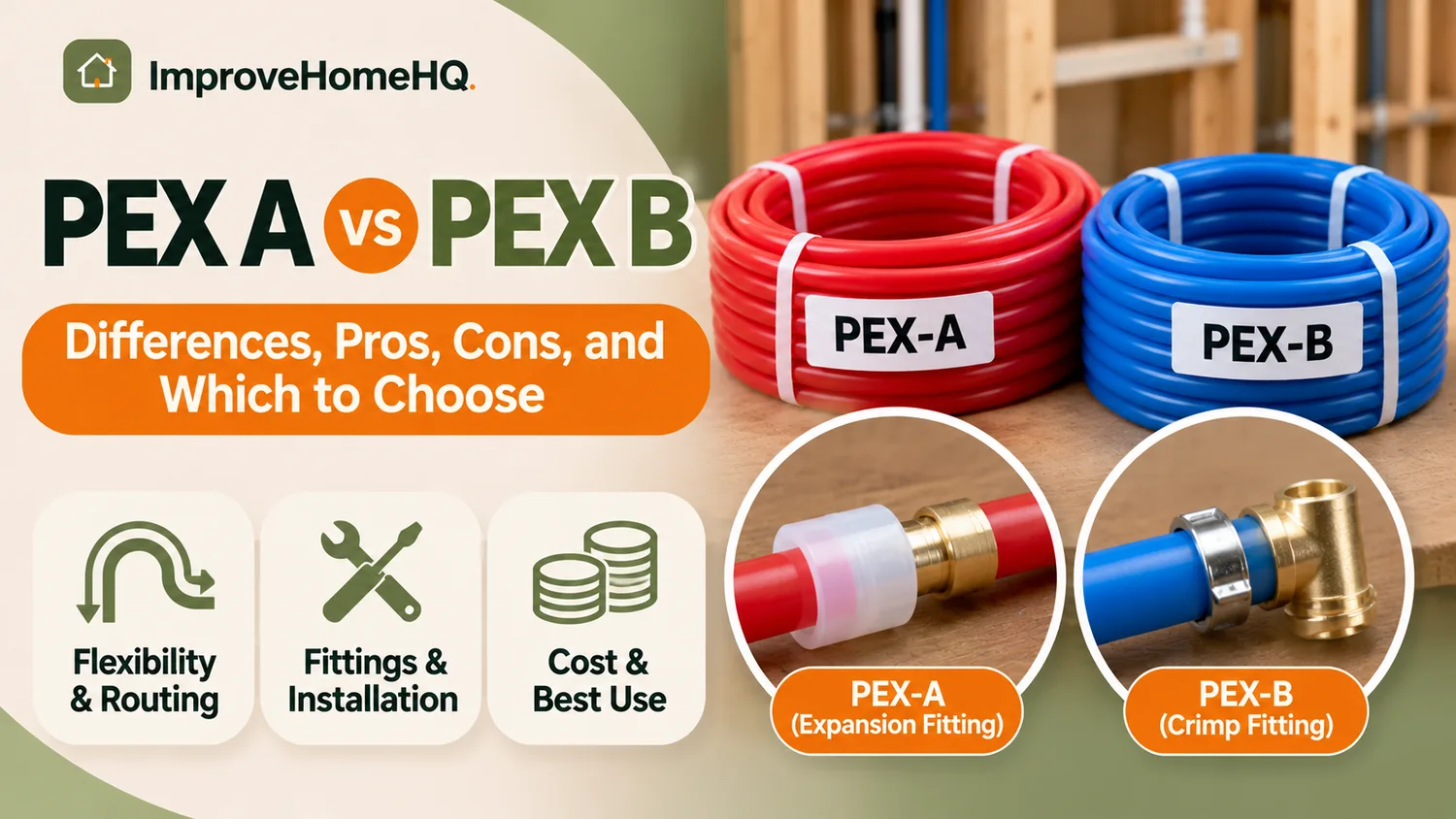
PEX A vs PEX B: Differences, Pros, Cons, and Which to Choose
Quick answer: PEX-A is generally more flexible and is commonly used with cold-expansion fittings, making it appealing for tight routing and whole-house repiping. PEX-B is usually less expensive and commonly installed with crimp or clamp fittings, making it a practical choice for straightforward plumbing projects. Both can serve hot- and cold-water lines when properly rated, certified, and installed. Neither letter means “better quality”: choose the specific tubing and approved fitting system for your layout, budget, and local plumbing code.
If you’re replacing aging water lines or running supply pipes to a bathroom, the differences between PEX tubing types can be confusing. One installer may recommend expansion connections; another may prefer inexpensive crimp fittings. Both approaches can be sound.
The useful question isn’t which letter wins. It’s which complete plumbing system will be easiest to install correctly and deliver the water flow your home needs.
PEX A vs PEX B: Side-by-Side Comparison
| Feature | PEX-A | PEX-B |
|---|---|---|
| Manufacturing method | Peroxide (Engel) crosslinking | Silane (moisture-cure) crosslinking |
| Typical flexibility | More flexible | Generally stiffer |
| Common connection method | Cold expansion; other approved methods may also work | Crimp, clamp, push-to-connect, or other approved methods |
| Expansion connections | Commonly approved for ASTM F1960 | Only when the specific product is approved for that system |
| Crimp or clamp connections | Often permitted; verify tubing markings | Commonly permitted |
| Kink repair | Some products permit a prescribed heat-repair method | Typically cut out the damaged section |
| Cost | Usually higher tubing cost; expansion tools add expense | Usually lower tubing and tooling cost |
| Water flow | Expansion fittings may have a larger opening than insert fittings | Insert fittings may add more local pressure loss |
| Freeze protection | Not freeze-proof | Not freeze-proof |
| Drinking-water suitability | Requires appropriate potable-water certification | Requires appropriate potable-water certification |
| Best fit | Complex routing, expansion-system installations | Budget-focused jobs using approved crimp/clamp systems |
Bottom line: The pipe’s printed ratings, approved fittings, and actual layout matter more than the A or B label alone. The Plastics Pipe Institute (PPI) design guide describes the shared standards and the different joining systems.
What Are PEX-A and PEX-B Pipes?
PEX stands for crosslinked polyethylene. Crosslinking creates bonds between polymer chains that help the tubing withstand the operating conditions expected in plumbing systems. PEX is widely used in residential water distribution because it is flexible, lightweight, and resistant to the internal corrosion associated with metal piping.
PEX-A and PEX-B are not different grades of plastic, and the letters do not indicate a first- and second-class product. They identify different manufacturing processes:
- PEX-A: Crosslinked using a peroxide-based process, commonly called the Engel method, during manufacturing.
- PEX-B: Crosslinked using a silane process, followed by moisture curing.
The manufacturing route influences how a particular pipe bends and responds to expansion. It does not, by itself, establish its chlorine resistance, pressure rating, service life, or drinking-water certification.
There is also PEX-C, produced by electron-beam irradiation. It is another manufacturing category, not a lower quality grade. This comparison focuses on the two options homeowners most often encounter for supply plumbing.
Six Differences That Matter in a Real Plumbing Job
1. Flexibility and routing around obstacles
PEX-A generally bends more readily, which helps when snaking a continuous line through floor joists, stud bays, or an existing house with limited access. Fewer changes of direction can mean fewer elbows and less installation work.
PEX-B is typically stiffer. It still bends, but certain layouts may need a wider turn, a bend support, or an approved elbow. Do not assume one universal minimum bend radius: follow the published limit for the tubing’s brand, diameter, temperature, and installation conditions.
For an open basement with long, straight runs, the flexibility difference may barely matter. For a retrofit requiring numerous turns through tight framing, it can matter a lot.
2. Fittings and installation tools
This is often the deciding factor.
Cold-expansion systems: A compatible expansion tool temporarily enlarges the tubing and reinforcing ring so an approved fitting can be inserted. The assembly then contracts around the fitting. These connections are commonly associated with PEX-A and ASTM F1960.
Crimp systems: An approved insert fitting goes inside the tubing and a copper ring is compressed with a calibrated crimp tool. Common relevant fitting specifications include ASTM F1807 for metal insert fittings and ASTM F2159 for plastic insert fittings.
Clamp systems: An approved stainless-steel clamp is tightened around the tubing over the fitting; ASTM F2098 covers stainless-steel clamps for these connections.
Push-to-connect systems: Certain listed fittings can connect compatible PEX tubing without conventional crimp or expansion tools. Approval depends on the particular fitting and tubing, not merely on the PEX letter.
Many PEX-A pipes can also use approved crimp or clamp systems. Some PEX-B products may be rated for expansion connections; others are not. Never assume that all PEX-B can be expanded or that every PEX-A product accepts every fitting. Check the tubing printline, fitting specifications, and manufacturer compatibility instructions.
A product from SharkBite, Viega, Zurn, REHAU, or Uponor/GF Building Flow Solutions should be installed according to that manufacturer’s current system documentation. A fitting that physically fits is not necessarily an approved joint.
3. Water flow and pressure loss
Homeowners sometimes hear that PEX-B automatically produces poor water pressure. That’s misleading.
Both pipe types can be manufactured to the same dimensional requirements under ASTM F876. The bigger distinction is often the fitting opening, not the pipe itself. Some cold-expansion fittings have a larger internal passage than conventional insert-type crimp fittings of the same nominal size. A smaller opening creates additional local resistance to flow.
But actual performance depends on the entire system: incoming pressure, pipe size, run length, elevation, fixture demand, number of bends, fittings, and valve restrictions.
Example: Suppose an upstairs shower has two showerheads intended to run together. Rather than automatically buying PEX-A, determine the shower’s combined rated flow, available supply pressure, and allowable pressure loss. Then size the branch and fittings accordingly. A well-designed PEX-B system can outperform an undersized PEX-A system.
Don’t automatically upsize every PEX-B line, either. Oversizing adds cost and increases the volume of water sitting in the pipe. Use fixture-demand calculations and the sizing guidance in the PPI 2026 design and installation guide. For complicated multi-fixture arrangements, consult a plumber who can calculate the demand and pressure losses.
4. Kinks and repairability
Some PEX-A products have sufficient shape-memory behavior for a manufacturer-approved heat procedure to restore a kinked section. That is a convenience during installation, not permission to apply a heat gun to any pipe.
For PEX-B, a kinked section is generally removed and replaced with an approved coupling or new tubing. For either type, follow the manufacturer’s written instructions and replace material showing cuts, cracks, overheating, or other damage.
Do not use an open flame or improvise a repair. Excessive heating can damage tubing and can invalidate product requirements or warranties.
5. Freeze resistance and long-term durability
PEX can accommodate some movement from freezing better than many rigid piping materials, but neither type is freeze-proof. Ice can still block a line; tubing, fittings, and nearby components can still be damaged. Repeated freezing is not a safe operating condition.
Protect pipes from freezing by locating them within conditioned spaces where practical, insulating vulnerable areas, sealing cold air leaks, and following local code. Do not choose PEX-A as a substitute for freeze protection.
Claims that one type universally lasts longer or that a single laboratory burst-pressure figure proves superior real-world durability are not justified. Service life depends on approved operating conditions, water chemistry, temperature, pressure, UV exposure, installation quality, and the specific product’s ratings.
Both types are subject to the applicable standards for their intended use. The A/B manufacturing letter alone does not establish which finished pipe will have greater chlorine resistance or a longer service life.
6. Material and total installation cost
PEX-B tubing generally costs less than PEX-A tubing, and many crimp or clamp tools have lower upfront prices than powered expansion tools. For a one-room DIY repair, the tools may determine which system is most economical.
For a larger repipe, the calculation changes. Flexible routing, fewer elbows, crew familiarity, tool rental or ownership, and the number of joints all affect labor costs. A contractor with an established expansion-tool setup may install a PEX-A system efficiently, even with higher tubing prices.
Avoid relying on fixed per-foot prices from older articles: prices vary by tube diameter, coil length, supplier, region, and date.
Compare complete quotes, including tubing, fittings, valves, tools, labor, permits, pressure testing, wall repairs, and warranty terms. A lower tubing price does not guarantee a lower finished project cost.
Which Type Is Better for Your Project?
| Project | Practical recommendation | Why |
|---|---|---|
| Whole-house repiping with difficult access | Consider PEX-A with a listed expansion system | Flexibility may simplify routing and reduce directional fittings |
| Straightforward basement or exposed supply runs | Consider PEX-B with approved crimp/clamp fittings | Often cost-effective without sacrificing required performance |
| One small DIY fixture supply repair | Match the existing certified tubing/fitting system | Avoid buying unnecessary tools or mixing incompatible components |
| Bathroom with multiple high-demand fixtures | Choose based on a sizing calculation | Pressure loss and supply capacity matter more than pipe letter |
| Cold-climate house | Either, with proper freeze protection | Neither material is immune to freezing damage |
| Recirculating hot-water system | Select a pipe with the correct chlorine/temperature ratings | Product-specific ratings matter more than manufacturing type |
For a whole-house repipe
Ask the contractor what exact tubing and fitting system they propose, how they will size branches, where they will route pipes, and which joints will remain accessible. Require a written description of the product and a clear testing and warranty plan. The workmanship and design can have a greater effect on the result than the letter printed on the tubing.
For a DIY installation
Choose a complete, documented system you can install with the correct tools. Crimp connections may be attractive because the tools are readily available, but they still require proper ring placement, correct tooling, and inspection or go/no-go checks where specified. Expansion joints also require precise technique and sufficient recovery time before pressurization, especially in cold conditions. Follow the manufacturer’s instructions rather than generalized online demonstrations.
Check permit requirements first. Some jurisdictions restrict homeowner plumbing work or require inspections, particularly for repiping and concealed connections.
How to Read the Markings on PEX Tubing
Before comparing brands, read the printing along the pipe itself. For residential drinking-water plumbing, look for:
- Manufacturer and product identification for traceability.
- Tube size and applicable standard, commonly ASTM F876 or ASTM F876/F877.
- Potable-water certification, such as listing to NSF/ANSI/CAN 61 by an accredited certification body; verify any additional local requirements.
- Pressure and temperature ratings appropriate to the proposed system.
- Approved joining standards and the manufacturer’s fitting compatibility information.
- PEX material designation code, indicating product-specific performance classifications.
For example, a code such as PEX 5306 contains useful information. Under the PPI guide, the first digit (5) corresponds to a chlorine-resistance classification for continuous hot-water recirculation conditions tested under the applicable standard; the second digit (3) indicates a six-month minimum UV-resistance classification under the relevant test procedure. The final two digits indicate hydrostatic design stress classification.
That does not mean you should leave the tubing in direct sun for six months. UV classes are product test classifications, not a blanket permission for outdoor exposure or rooftop installation. Follow the manufacturer’s more restrictive storage and installation instructions.
Likewise, a favorable chlorine rating does not eliminate concerns about water quality or temperature. Verify the product’s specific application, including any domestic hot-water recirculation loop.
The PPI guide’s material-properties chapter explains these markings in detail. For any purchase, check the actual label and current product listing rather than assuming all tubing from a brand has identical ratings.
Installation Mistakes to Avoid
- Mixing systems without checking approval. Pipe, rings, fittings, and tools must be compatible and installed as directed.
- Choosing solely by color. Red, blue, and white often indicate intended identification, not whether a pipe is A or B or what its chlorine rating is.
- Ignoring bend-radius and support requirements. Sharp bends, unsupported runs, or abrasion against framing can damage any tubing.
- Putting incompatible fittings in inaccessible locations. Follow code and product instructions for concealed joints and access.
- Over-tightening or misplacing rings. Use the correct tool settings and the manufacturer’s ring-position or inspection requirements.
- Exposing tubing to sunlight, chemicals, or excessive heat. Follow product limits; do not install against prohibited heat sources or allow contact with incompatible sealants and chemicals.
- Skipping testing. Pressure-test the installed system according to the manufacturer’s instructions and local code before closing walls.
- Guessing at supply-line size. Multiple fixtures and long runs require real demand and pressure-loss calculations.
A useful rule: buy the tubing, fittings, tools, and instructions as a matched system, then check local approvals before installation.
Common Questions
Can PEX-A and PEX-B be connected together?
Yes, if you use a fitting or transition method specifically approved for both tubing products and their sizes. Some crimp, clamp, or push-to-connect fittings support both types, but approval is product-specific. Never combine components solely because they appear to fit.
Can you use crimp fittings on PEX-A?
Often, yes. Many PEX-A products permit compatible crimp or clamp systems. Confirm the fitting standard on the tube’s markings and in the manufacturer’s current installation literature.
Can you use expansion fittings on PEX-B?
Only when the specific PEX-B tubing and fitting system are approved for that expansion connection. Most homeowners encounter PEX-B in crimp or clamp installations, but the letter alone is not a universal compatibility rule.
Is PEX-A safer for drinking water than PEX-B?
Neither letter alone determines drinking-water safety. Choose tubing and fittings with appropriate potable-water certifications, including NSF/ANSI/CAN 61 where required, and follow installation and flushing instructions. Compare actual product listings, not marketing claims.
Does PEX-B reduce shower pressure?
Not inherently. Certain insert fittings create more resistance than some expansion fittings, but properly sized branches can still serve a shower well. Available pressure, fixture flow, run length, and fitting layout determine results.
Does PEX-A handle freezing better?
PEX-A is generally more flexible, but that does not make it freeze-proof or establish a universal freeze-damage ranking. Prevent frozen pipes with correct placement, insulation, and cold-weather protection for either type.
How long does PEX last?
PEX is designed for long-term service within its rated conditions, but a fixed life expectancy cannot be guaranteed based on A versus B. Temperature, disinfectant exposure, pressure, UV light, and installation quality all matter. Use certified products and comply with manufacturer requirements.
Can PEX be used outdoors or underground?
Some specifically listed PEX products are suitable for underground water-service applications when installed as directed. Exposed outdoor sunlight is a different issue: PEX generally requires UV protection and must not exceed its product-specific exposure limits. Check local code, bedding, burial, and protection requirements.
Which one should I choose if I already own a crimp tool?
If the tubing is approved for your intended crimp system, either type may work. PEX-B is frequently an economical choice. There is usually no reason to buy an expansion tool solely because PEX-A is advertised as more flexible.
Final Verdict
For most homeowners, PEX-A is worth considering when flexibility and expansion connections simplify a complicated installation. PEX-B makes excellent sense when costs matter and a compatible crimp or clamp system suits the layout. Neither is automatically stronger, safer, or longer-lasting simply because of its manufacturing category.
The best choice is the correctly rated and certified pipe, paired with approved fittings, properly sized for the fixtures, and installed to the manufacturer’s instructions and local plumbing code. If a quote doesn’t specify those details, ask for them before deciding.
Sources and Further Reading
- Plastics Pipe Institute, PEX Plumbing Distribution Systems Design and Installation Guide, third edition (April 2026) — material properties, markings, design, fittings, and installation.
- SharkBite, The Differences Between PEX-A, -B and -C — manufacturer explanation of methods and certifications.
- NSF, drinking-water product certification information — verify the meaning of potable-water certifications and current product listings.