Propane Tank Sizes: Dimensions, Capacities, and How to Choose
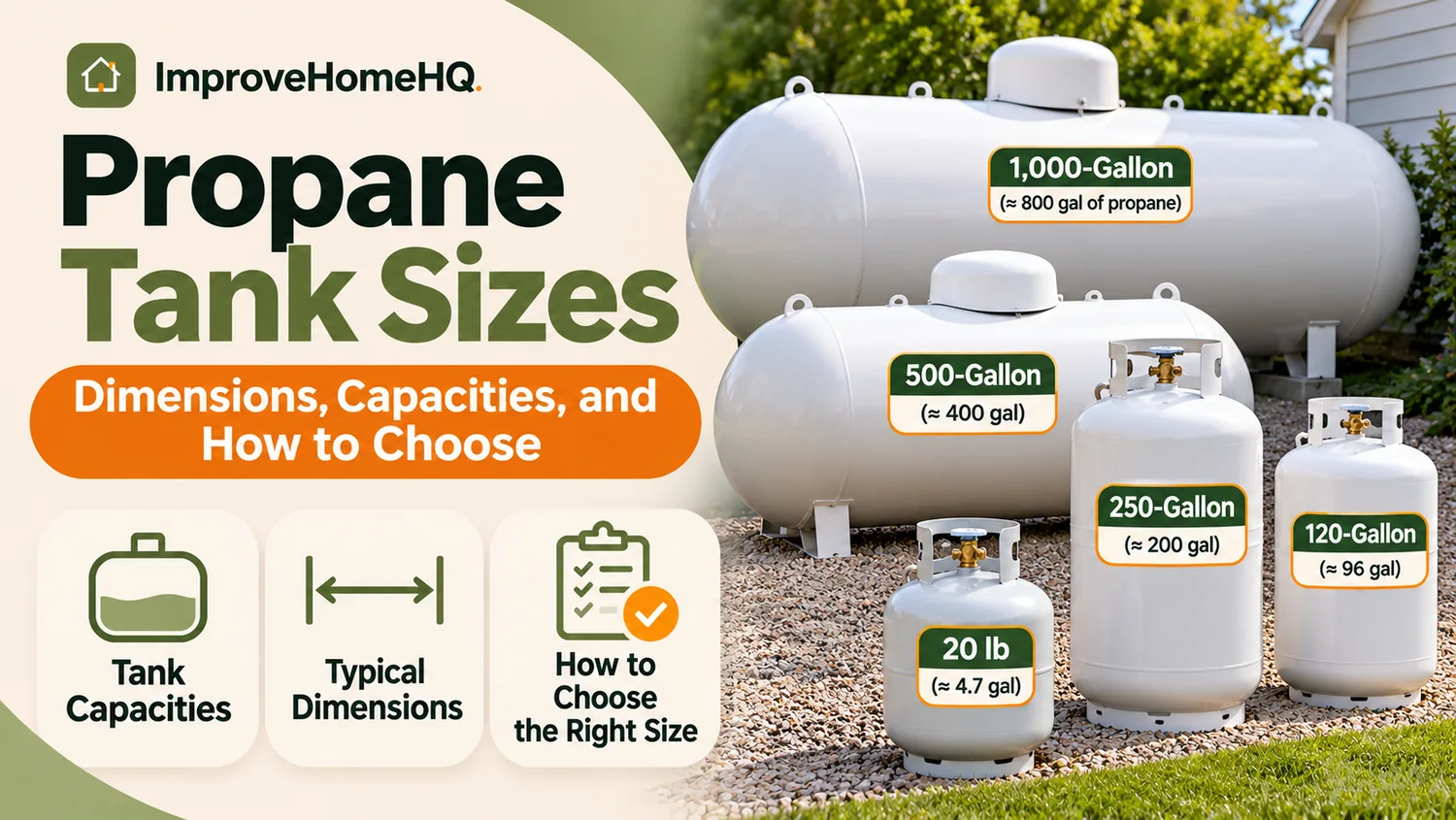
Quick answer: Common propane tank sizes range from portable 20-pound cylinders (about 4.7 gallons of propane) to stationary 120-, 250-, 325-, 500-, and 1,000-gallon tanks. A 120-gallon tank typically holds about 96 gallons when filled, a 500-gallon tank holds about 400 gallons, and a 1,000-gallon tank holds about 800 gallons. For a grill, a 20-pound cylinder is common; for a few household appliances, consider a 120- to 250-gallon tank; and for whole-home heating, a 500- or 1,000-gallon tank may be appropriate. Your actual fuel consumption, winter temperatures, appliance demand, and refill access determine the right choice.
A tank that is too small can mean frequent deliveries—or an empty tank during a cold snap. One that’s much larger than you need can take up unnecessary yard space and increase installation costs. The trick is to look beyond the number painted on the tank.
This guide compares standard sizes and dimensions, explains the 80% fill rule, and shows how to estimate a practical tank capacity for your home, RV, or outdoor equipment.
Propane Tank Sizes and Capacities Chart
Portable cylinders are generally labeled by the weight of propane they hold, while stationary residential tanks are usually identified by their total water capacity in gallons. That’s why a 100-pound cylinder and a 120-gallon tank are not remotely the same size.
| Nominal tank size | Approximate propane when filled | Typical dimensions* | Common applications |
|---|---|---|---|
| 20 lb cylinder | 4.6–4.7 gal | 18 in. high × 12 in. diameter | Grills, patio heaters, portable outdoor equipment |
| 30 lb cylinder | 7 gal | 24 in. high × 12.5 in. diameter | Travel trailers, RV appliances |
| 33 lb cylinder | 7.8–8 gal | Varies by forklift cylinder design | Forklifts and other designated equipment |
| 100 lb cylinder | 23–24 gal | Around 48 in. high; diameter varies | Single appliances, temporary approved setups |
| 57–59 gal tank (often called 200 lb) | 46–47 gal | Around 43 in. high × 24 in. diameter | Cooking, dryers, limited appliance use |
| 120 gal tank (often called 420 lb) | 96 gal | Around 54–55 in. high × 30 in. diameter | Water heating, fireplaces, a few appliances |
| 124 gal tank | About 99 gal | Varies by model | Similar uses to a 120-gallon tank |
| 250 gal tank | 200 gal | Around 7 ft 10 in. long × 30 in. diameter | Multiple appliances, some smaller heating loads |
| 325 gal tank | 260 gal | Around 10 ft long × 30 in. diameter | Moderate household demand, some generators |
| 500 gal tank | 400 gal | Around 9 ft 11 in. long × 37.5 in. diameter | Whole-home heating and multiple appliances |
| 1,000 gal tank | 800 gal | Around 16 ft 2 in. long × 41 in. diameter | Larger homes, heavy heating loads, small businesses |
*Dimensions are representative supplier examples, not standardized installation footprints. Actual models, supports, valve guards, and underground configurations vary. Capacities are approximate; the permitted fill depends on the container, temperature, and applicable filling procedures. Sources: AmeriGas, Ferrellgas, Superior Plus Propane, and PepUp.
Remember: A “500-gallon tank” does not normally contain 500 gallons of liquid propane. Its nominal size describes the tank, not the delivery amount.
Common Propane Tank Sizes Explained
20-, 30-, and 33-Pound Cylinders
The familiar 20-pound grill cylinder holds roughly 4.6–4.7 gallons of propane. It is suited to standard gas grills, patio heaters, and compatible portable appliances. A 30-pound cylinder carries approximately 7 gallons and is commonly seen on travel trailers.
A 33-pound cylinder is often designed for forklift service. Do not substitute a forklift cylinder for a grill or RV cylinder just because the capacities seem similar: valves, liquid-versus-vapor withdrawal arrangements, and approved orientations differ. Use only the container specified for the equipment.
Portable cylinders also require safe outdoor storage and appropriate handling. Never keep a spare cylinder inside your house, basement, or enclosed garage.
100-Pound Cylinders
A 100-pound cylinder typically holds about 23–24 gallons of propane. It can serve certain single-appliance applications, such as a fireplace or a cooking appliance, if properly installed and approved for that use.
It is considerably heavier than a grill cylinder and is not a convenient substitute for a permanent whole-house installation. Ask your supplier about the required regulator, connections, delivery method, and location before selecting one.
57- to 59-Gallon Tanks
Often marketed as 200-pound tanks, these smaller stationary containers hold approximately 46–47 gallons when filled. They make sense when a house uses propane only for cooking, a clothes dryer, or another low-demand appliance.
The precise labeled tank size matters. A supplier may list a 57-gallon or 59-gallon model, and the gallons delivered can differ accordingly.
120- and 124-Gallon Tanks
A 120-gallon tank normally contains around 96 gallons of propane at an 80% fill. A 124-gallon model holds approximately 99 gallons on the same basis. Some suppliers refer to this class as a 420-pound tank.
These upright tanks are a frequent choice for propane water heaters, fireplaces, ranges, dryers, and other limited-demand applications. They are usually too small to be a comfortable default for sustained whole-home heating in a cold climate, although actual suitability depends on the heating load and refill plan.
A contractor may suggest more than one smaller tank when site constraints make a larger container impractical. Multiple tanks must be configured and evaluated by qualified professionals.
250-Gallon Tanks
A 250-gallon tank normally holds around 200 gallons when filled. It offers more storage for a household with several propane appliances or a modest heating load.
It may be a reasonable middle ground for a smaller, efficient home in a relatively mild climate. But a house with a large furnace, frequent generator use, or long, cold winters may need substantially more fuel storage.
325-Gallon Tanks
At approximately 260 gallons of propane when filled, a 325-gallon tank bridges the gap between 250- and 500-gallon models. It is useful where the estimated consumption or delivery schedule makes a smaller tank inconvenient but the larger option is unnecessary or hard to accommodate.
Availability varies by supplier. Before choosing one, confirm that local deliveries, installation services, and the exact tank model are offered in your area.
500-Gallon Tanks
A 500-gallon tank holds approximately 400 gallons when filled and is a common starting point for houses using propane for central heating plus water heating, cooking, or other appliances.
Its popularity does not mean it is automatically right for every home. A well-insulated small house in a mild region and a drafty house in northern New England can consume very different amounts of propane, even if both have the same number of occupants.
1,000-Gallon Tanks
A 1,000-gallon tank typically holds about 800 gallons when filled. This size is worth evaluating for larger properties, higher annual fuel use, substantial generator loads, or places where winter deliveries can be difficult.
Larger tanks require more physical space, careful placement, and greater delivery access. Some homes may benefit from two tanks rather than one, but that design needs professional review for code compliance and adequate vapor supply.
Why Propane Tanks Are Usually Filled to About 80%
Propane is stored as a liquid under pressure. Because the liquid expands as its temperature rises, the tank must retain vapor space rather than being filled completely with liquid. For many common stationary tanks, an approximately 80% liquid fill is the practical reference point.
The basic comparison is:
Nominal tank capacity × 0.80 = approximate gallons of propane at a typical full fill
For example:
- 120 gallons × 0.80 = 96 gallons
- 250 gallons × 0.80 = 200 gallons
- 500 gallons × 0.80 = 400 gallons
- 1,000 gallons × 0.80 = 800 gallons
The same shortcut should not be applied mechanically to portable cylinders. A 20-pound cylinder is rated by the permitted weight of propane, not by “20 gallons.” It carries roughly 4.7 gallons because liquid propane weighs about 4.2 pounds per gallon at 60°F. Filling is performed by trained personnel under the applicable procedure, using weight or approved liquid-level controls rather than a homeowner’s calculation.
Sources: U.S. Department of Energy, propane properties and Propane Education & Research Council (PERC), propane expansion and fill guidance.
What Size Propane Tank Do I Need for My House?
Start with how many gallons you use, not just square footage. Home size is a helpful clue, but insulation, local climate, heating-system efficiency, thermostat settings, and the number of propane appliances can change consumption dramatically.
1. Identify Every Propane-Powered Appliance
Write down every connected appliance: furnace or boiler, water heater, range, dryer, fireplace, pool heater, space heater, and standby generator. Check each nameplate or manual for its input rating in BTU per hour (BTU/h).
A propane appliance rated at 60,000 BTU/h does not necessarily consume that much fuel every hour of the day. Heating equipment cycles on and off, and generators may have different fuel consumption at different electrical loads.
2. Estimate Fuel Use in Gallons
The U.S. Energy Information Administration lists propane at approximately 91,452 BTU per gallon. For a basic fuel-input estimate:
Gallons consumed ≈ appliance input (BTU/h) × hours operating ÷ 91,452
Example: A 60,000-BTU/h propane burner operating at that input for 30 total hours uses approximately:
60,000 × 30 ÷ 91,452 = 19.7 gallons
For a modulating furnace, calculate from realistic operating load or—better yet—use past delivery records. Do not use the furnace’s advertised heat output in a fuel-input calculation without accounting for efficiency.
3. Use Winter Consumption, Not Your Annual Average
Suppose your records show 100 gallons used during an average summer month but 220 gallons during a colder winter month. A tank sized around the summer figure could require urgent winter refills.
Review several months of deliveries if possible. If you’re moving into a new home, ask the previous owner or propane company for historical gallon usage, while recognizing that occupants and thermostat settings may differ.
Also account for planned additions. A new standby generator, pool heater, or finished addition can alter the size recommendation substantially.
4. Choose a Refill Window and Safety Margin
You should not plan to use every gallon between an 80% fill and an empty tank. Set a refill threshold with your supplier—often around 20–30% on the tank gauge, depending on the delivery plan and season.
For example, a 500-gallon tank going from an 80% gauge reading to a 20% reading provides approximately:
500 × (0.80 − 0.20) = 300 gallons between those levels.
If your household uses an estimated 200 gallons in a difficult winter month, that represents about 1.5 months of supply between those gauge readings, assuming consumption stays constant. It is an illustration, not a guarantee: severe weather, unexpected generator run time, and delivery delays can shorten that window.
| Tank | Gallons between 80% and 20% gauge readings | Days at 5 gal/day | Days at 10 gal/day |
|---|---|---|---|
| 120 gal | 72 | 14 | 7 |
| 250 gal | 150 | 30 | 15 |
| 325 gal | 195 | 39 | 19 |
| 500 gal | 300 | 60 | 30 |
| 1,000 gal | 600 | 120 | 60 |
Planning examples only; rounded down to whole days. Actual consumption and gauge readings vary.
5. Confirm the Tank Can Supply Enough Gas in Cold Weather
Storage volume and vaporization capacity are different things. A tank may hold enough propane for several weeks but still fail to supply a high-BTU appliance reliably in very cold conditions.
As liquid propane vaporizes to feed gas appliances, its temperature and the amount of liquid in contact with the tank’s interior affect how much gas can be supplied. Colder weather and low liquid levels can reduce vaporization performance.
Manufacturer L.B. White’s propane tank sizing guide demonstrates that tank diameter, length, air temperature, fuel level, and connected heat load all matter. In its example, a 250-gallon tank that is adequate near 0°F becomes inadequate for the same 170,000-BTU/h load at −10°F.
This is especially relevant to high-demand heaters and generators. Have the propane supplier or qualified gas professional verify both storage capacity and worst-case vapor delivery, rather than sizing from gallons alone.
Choosing a Tank by Application
| Application | Sensible starting point | What to verify |
|---|---|---|
| Standard gas grill | 20 lb cylinder | Correct valve, cylinder type, and appliance compatibility |
| Travel trailer or RV | Commonly 20 or 30 lb removable cylinders; some RVs use fixed ASME tanks | RV manufacturer’s requirements and permitted mounting |
| Range or clothes dryer only | 100 lb cylinder or roughly 57–120 gal stationary tank | Actual usage, delivery and installation arrangements |
| Water heater and a few appliances | Roughly 120–250 gal | Daily gallons and seasonal loads |
| Smaller home with propane heating | Often 250–500 gal | Heat loss, local winter conditions, refill access |
| Whole-home heating plus several appliances | Often 500 gal or more | Peak winter use and vaporization capacity |
| Larger home or high-use rural property | Consider 1,000 gal | Annual and peak consumption, setbacks, truck access |
| Standby generator | Depends heavily on model and expected runtime | Manufacturer’s gallons-per-hour table at expected load |
These are starting points, not universal specifications. A large generator could exhaust a relatively small tank rapidly, while an efficient, lightly used fireplace may require far less storage.
Aboveground vs. Underground Propane Tanks
Aboveground Tanks
Aboveground installations are generally easier to inspect and less expensive to install because they do not require burial excavation or a specially designed underground tank. The equipment remains visible and needs accessible space for filling, inspection, and service.
You cannot simply conceal a tank with tightly packed landscaping or fencing. Clearances, ventilation, access, and the supplier’s operating requirements still apply.
Underground Tanks
An underground installation keeps most of the container out of view, leaving an accessible dome for the connections and service equipment. The design requires an approved tank intended for burial, excavation, corrosion protection, and access to required components.
The extra site work usually increases installation cost. Underground placement does not eliminate setback requirements; a qualified installer must review local codes, property lines, underground utilities, drainage, and truck access.
Important: Aboveground and underground tanks are not interchangeable. Never bury an ordinary aboveground container.
Propane Tank Placement and Safety Requirements
Propane containers must be installed according to the applicable code, tank listing, equipment instructions, and local authority requirements. NFPA 58 (Liquefied Petroleum Gas Code) is a central U.S. reference for LP-gas storage and installations, but the adopted edition and local amendments can differ.
For example, a 500-gallon aboveground residential tank commonly requires a 10-foot minimum separation from a building and a buildable property line, while certain 1,000-gallon aboveground installations require 25 feet. Underground rules differ, and there are additional requirements for fill points, relief valves, ignition sources, openings, and regulators. Small tanks can have different placement rules.
Do not use those two example distances as a site plan. Have the supplier verify all applicable clearances, including the adopted NFPA 58 edition and local fire/building requirements.
Other essential safety practices:
- Keep portable cylinders upright during ordinary storage and transport, unless the manufacturer’s approved equipment arrangement specifies otherwise.
- Store cylinders outdoors, away from ignition sources, and never in an enclosed living area.
- Do not modify valves, regulators, or fittings yourself.
- Maintain access for filling, inspections, emergency response, and snow removal.
- Have a qualified technician inspect the system and perform required leak checks after a run-out or when service work requires them.
- Check portable cylinders for damage and current requalification markings. PHMSA explains that DOT cylinders generally require requalification or replacement at specified intervals, often five or ten years depending on method and markings.
If you smell propane: Avoid flames, electrical switches, and phones in the affected area. Leave immediately. If safe to do so, shut off the main tank valve; from a safe location, call your propane supplier or 911. Do not return or restart appliances until qualified personnel say it is safe. Follow PERC’s gas-leak instructions.
Should You Buy or Lease a Propane Tank?
Buying can provide more control over the container and, subject to contract and supplier rules, the ability to shop among propane delivery companies. But the owner may be responsible for maintenance, repairs, inspections, and future replacement.
Leasing or supplier-provided tanks may reduce upfront cost, although leases can include minimum annual gallon commitments, rental or service fees, and exclusive fuel-delivery requirements.
Before committing, compare the total cost, not only the price per gallon:
- Tank purchase price or annual lease fee
- Installation, pad or excavation, permits, and gas-line work
- Fuel price and minimum delivery quantities
- Monitoring, maintenance, inspections, and service responsibilities
- Delivery access, emergency service, and contract termination terms
Ask for a written quote based on your actual site and predicted fuel use. Prices vary too much by location and project to make a fixed national installation price reliable.
Common Propane Tank Sizing Mistakes
Choosing solely by house size. Two houses with identical floor areas can have very different heating loads. Past fuel consumption and a heating-load calculation provide a sounder basis.
Confusing tank capacity with propane delivered. A 500-gallon tank generally holds roughly 400 gallons at a typical full fill, not 500.
Ignoring winter vaporization. Enough gallons on paper does not guarantee adequate gas delivery during extreme cold and heavy appliance demand.
Forgetting the generator. Generator runtime during a multiday outage can change your storage needs dramatically. Use the generator manufacturer’s fuel-use figures.
Waiting until the gauge reads empty. Schedule refills with enough time to allow for bad weather and truck availability. Running out can require additional safety procedures before service is restored.
Buying a tank before checking the site. Confirm setback distances, delivery-truck access, underground utilities, and whether a supplier will service that container.
Frequently Asked Questions
What is the most common propane tank size for a house?
A 500-gallon tank is a common option for homes using propane for central heating and several appliances. Homes that use propane only for cooking or water heating often need much smaller tanks. The correct size depends on gallons consumed and the delivery schedule.
How many gallons are in a 100-pound propane tank?
A standard 100-pound propane cylinder holds approximately 23–24 gallons. The exact liquid volume depends on temperature and propane density. The “100 pounds” refers to the nominal weight of propane, not the weight of the empty cylinder.
How big is a 500-gallon propane tank?
A common horizontal 500-gallon tank is approximately 9 feet 11 inches long and 37.5 inches in diameter. Dimensions vary by manufacturer, so check the exact tank drawing and allow additional space for code-required clearances and service access.
How long will a 500-gallon propane tank last?
It depends on consumption. Between 80% and 20% gauge readings, the tank provides roughly 300 gallons. At 5 gallons per day, that is about 60 days; at 10 gallons per day, about 30 days. Cold weather and high appliance use can shorten the interval significantly.
Is a 250-gallon tank enough to heat a house?
Possibly, for a modest heating load with dependable refills. A 250-gallon tank contains about 200 gallons at a typical full fill, but both peak fuel demand and cold-weather vaporization need to be checked before relying on it for central heating.
Can you fill a propane tank to 100%?
No. Propane containers need space for thermal expansion. Many stationary tanks are filled to approximately 80% liquid volume under typical conditions, while DOT cylinders are filled according to applicable weight and filling requirements. Only qualified personnel should fill containers.
What is the difference between a 120-gallon tank and a 420-pound tank?
They often refer to the same general size class. A 120-gallon tank holds approximately 96 gallons at an 80% fill, which weighs about 403 pounds at 60°F; “420-pound” is a common trade designation, not an exact weight of the fuel in every fill.
Can I install a residential propane tank myself?
Tank placement, gas piping, regulators, pressure testing, and commissioning should be handled by appropriately qualified professionals under local requirements. Incorrect installation can cause a serious fire or explosion hazard.
Bottom Line
The best tank is the one that covers your peak demand, allows a practical refill schedule, and can be installed safely on your property. A 20-pound cylinder is usually enough for a grill; smaller stationary tanks serve limited household appliances; and 500- or 1,000-gallon tanks are often considered for broader home-heating needs.
Before ordering, gather your appliance ratings, recent propane bills, expected winter usage, and a rough site layout. Ask a local propane professional to verify tank capacity, cold-weather vaporization, code-required clearances, and delivery access. Those checks matter far more than choosing by square footage alone.