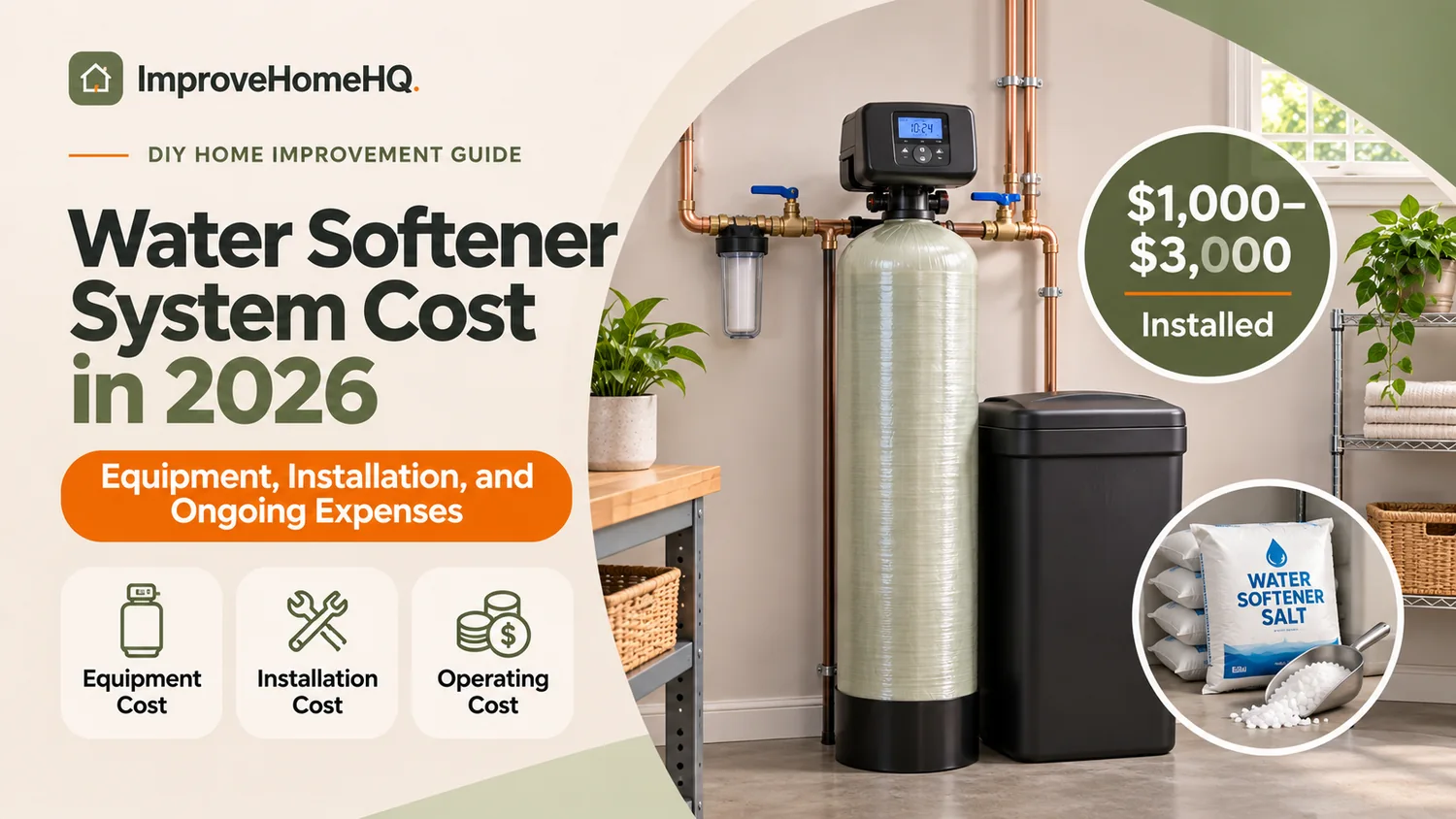
Water Softener System Cost in 2026: Equipment, Installation, and Ongoing Expenses
A water softener typically costs about $1,000 to $3,000 installed for a straightforward residential project, although a basic unit with an easy plumbing connection can cost less and premium or complicated installations can exceed $4,000. The equipment itself may cost roughly $400 to $3,000, with professional installation commonly adding $150 to $1,000. The final price depends on the type and size of system, your water quality, and the plumbing already in place.
Those are planning ranges, not a single national price guarantee. For example, Home Depot lists a Rheem 32,000-grain softener for approximately $489, while Aqua Systems of Indianapolis advertises a conventional system at $999 before its listed optional installation charge. Dealer-installed packages can cost considerably more.
The best way to budget is to separate the purchase price, installation charges, and running costs—and make sure you’re comparing actual softeners rather than products that only claim to reduce scale.
Water Softener System Cost at a Glance
| Expense | Typical budget range | What to know |
|---|---|---|
| Basic salt-based softener | 400–800 | Retail equipment only; household-size models |
| Midrange or higher-capacity softener | 800–2,000 | Equipment only; features and capacity vary |
| Premium or specialty system | 2,000–5,000+ | Equipment or dealer package; confirm what’s included |
| Professional installation | 150–1,000 | Higher if new plumbing, drain or electrical work is needed |
| Straightforward installed project | 1,000–3,000 | Practical planning range, not a guaranteed quote |
| Salt-based system operating supplies | Roughly 60–180 per year | Illustrative salt budget; actual salt, water and maintenance costs vary |
| Rental | Around 25–50 per month | Contract terms, service and salt may be extra |
Price note: Figures are approximate U.S. consumer budgeting ranges as of November 2026, compiled from current retail listings and installer pricing guides; they are not a statistically measured national average. Equipment-only and fully installed prices should not be compared as if they cover the same work.
How Much Does a Water Softener Cost by Type?
Not everything marketed as a “water softener” removes hard-water minerals. That distinction matters when comparing prices.
Single-tank salt-based water softeners
A conventional ion-exchange softener uses resin to exchange calcium and magnesium—the minerals that cause hardness—for sodium or potassium ions. This is the standard choice when you want measurably softer water throughout the home. The U.S. Environmental Protection Agency (EPA) confirms how these systems work.
Expect approximately 400–1,700 for many single-tank residential units, although higher-end models cost more. Entry-level cabinet models combine the resin and brine storage in a compact housing; separate-tank designs can offer more configuration and service options. Buy based on actual softening performance, service flow rate and water use—not appearance alone.
Dual-tank water softeners
Twin-alternating systems have two resin tanks, allowing one to supply softened water while the other regenerates. They can be useful in high-demand households or situations where continuous soft-water availability matters.
Prices often run 1,000–5,000 for the system, depending on capacity and controls, with installation extra unless sold as a package. Most ordinary households do not need two resin tanks solely because they have several bathrooms. i
Salt-free water conditioners
A salt-free conditioner is generally marketed to reduce scale formation without using a salt-regeneration cycle. It does not remove calcium and magnesium in the way an ion-exchange softener does. You may still measure the same hardness level after treatment.
Equipment can cost roughly 800–4,000, depending on design and size. Consider one only if its claimed scale-control performance fits your goals, and ask for independent evidence specific to the product. If you want soft water for soap performance and hard-water spotting, don’t assume a conditioner will deliver the same result.
Magnetic and electronic descalers
These devices often sell for 100–600, but they are not ion-exchange water softeners. Claims about scale reduction depend on the technology and conditions, and a low purchase price is not proof that the device will solve your home’s hardness problem. Ask for credible, product-specific test results before purchasing.
What about reverse osmosis? Reverse osmosis (RO) is a separate treatment technology, commonly used for drinking water at a particular faucet. It should not be counted as a direct substitute for a whole-house ion-exchange softener. An RO filter may be an additional purchase if your drinking-water test shows a need for treatment.
What Affects the Final Installed Price?
Water hardness and household demand
Harder water contains more dissolved calcium and magnesium. It increases the work the softener must perform and can increase salt and regeneration-water consumption. More people and greater water use also raise demand.
The U.S. Geological Survey classifies water as soft at 0–60 mg/L, moderately hard at 61–120 mg/L, hard at 121–180 mg/L, and very hard above 180 mg/L, expressed as calcium carbonate. One grain per gallon (gpg) is approximately 17.1 mg/L.
Do not choose a larger system automatically. A properly sized, efficient model may be a better value than an oversized one with unsuitable settings.
Capacity and flow rate
The “32,000-grain” or “48,000-grain” figure in a product name is not necessarily the amount of hardness removed at the most salt-efficient operating setting. Usable capacity changes with salt dose. For example, Pentair’s published specifications show different grain capacities for the same model at different salt dosages. Also check the rated service flow in gallons per minute (gpm), especially in homes where several fixtures run at once.
Existing plumbing and installation location
A pre-plumbed softener loop near a suitable drain and electrical outlet can simplify installation. Costs climb when the plumber must reroute supply lines, install shutoffs, make a compliant drain connection, run a new outlet or move the equipment to another room.
Installation also needs enough space to service the unit and add salt. Ask whether outdoor hose bibs and irrigation lines will bypass the softener, so you’re not paying to soften water that doesn’t need it.
City water versus private well water
City-water homeowners can begin with the utility’s water-quality report and a hardness measurement at the home. Well-water owners may need more testing for iron, manganese, sediment, pH or other local concerns. A water softener is not a universal drinking-water purifier, and iron-heavy or sediment-laden water can require separate pretreatment.
The Centers for Disease Control and Prevention recommends annual private-well testing for total coliform bacteria, nitrates, total dissolved solids and pH, with additional tests based on local conditions. Hardness testing is a separate useful step when choosing a softener.
Brand, controls and service arrangement
Retail models from Rheem, GE and Aquasure occupy a different buying channel from professionally quoted systems from companies such as Culligan, Kinetico and EcoWater. A higher quote may include design, installation, proprietary equipment, a warranty and scheduled service—or charges you do not actually need.
Compare scope and written terms, not just brand names. A metered, demand-initiated regeneration control is a useful feature because it responds to usage instead of regenerating strictly on a calendar schedule.
How Much Does Professional Water Softener Installation Cost?
Budget roughly 150–1,000 for typical professional installation labor, but extensive plumbing changes can push a project higher. Local labor rates, existing connections and permit requirements make a meaningful difference.
A plumber’s quote should identify whether it includes:
- Connection to the main cold-water supply, including isolation and bypass valves.
- A drain connection and required air gap or other locally approved backflow protection.
- Overflow handling where applicable, plus appropriate electrical access.
- Any new pipe, fittings, disposal of the old unit, permits and inspection fees.
- Startup, leak testing, hardness programming and a demonstration of the controls.
A permit may not be needed for every replacement, but local plumbing rules apply. Some jurisdictions also restrict where softener discharge can go. Get the requirements from your building department or wastewater authority rather than assuming a nearby floor drain is acceptable.
Example: a straightforward installation
Suppose you buy a $700 softener, pay $450 for installation and spend $100 on miscellaneous fittings and supplies. Your initial total is $1,250, before any applicable tax or permit. That is an illustrative estimate, not a contractor quote.
Example: a more complicated installation
A $1,500 system, $900 in plumbing and labor, and $300 for additional installation materials would total $2,700 before any required permit, water pretreatment or taxes. Two similarly sized homes can receive different quotes simply because one already has the necessary connections.
DIY versus hiring a plumber
If the softener loop, drain and outlet already exist, an experienced DIYer may save on labor. But connecting to a potable-water supply creates real risks: leaks, cross-connections, improper drainage and code violations. Some manufacturers also impose installation conditions on their warranties.
For most homeowners, professional installation is the safer choice when pipes must be cut or rerouted. Get a written labor-only estimate before buying equipment separately; some installers will not warrant customer-supplied units.
How Much Does a Water Softener Cost to Run Each Month?
Salt is usually the most visible ongoing expense. Water used during regeneration, electricity and occasional service also matter.
Salt and potassium chloride
For an illustrative household using six to twelve 40-pound bags of salt per year at 10–15 per bag, salt costs 60–180 annually, or about 5–15 per month. This is a sample budget—not a claim that every household uses that much. Highly efficient equipment, mild hardness and low usage may consume less; larger households with very hard water may consume more.
Potassium chloride is an alternative regenerant for systems rated to use it, but it generally costs more than ordinary sodium chloride. Check the owner’s manual before switching.
Regeneration water and electricity
An ion-exchange softener periodically flushes its resin using brine and rinse water. Metered municipal-water customers pay for that water and, depending on the utility, may also incur sewer charges. Private-well owners do not receive a metered municipal-water bill, but pumping the water still uses electricity and the discharge needs proper management.
The actual cost depends on gallons used per regeneration, regeneration frequency and local rates. Ask the manufacturer for water use per regeneration and the efficiency specifications, rather than accepting a generic promise that the system costs almost nothing to operate.
Maintenance and repairs
Homeowners commonly refill salt, inspect the brine tank and check for salt bridges. EPA recommends annual professional service, periodic salt checks and cleaning the brine tank about once a year. Repairs such as a failed valve, motor, seal or resin replacement add variable costs over a system’s life.
Before purchasing a service agreement, ask what visits, parts, labor, salt delivery and emergency calls it actually covers.
The Real Cost Over 10 Years
Purchase price alone can make an inexpensive system look like the best deal. A longer view is more useful.
| Expense | Illustrative 10-year example |
|---|---|
| Equipment and installation | $1,500 |
| Salt: $120 per year | $1,200 |
| Added regeneration water and electricity: $35 per year | $350 |
| Allowance for nonroutine maintenance and repairs | $300 |
| Illustrative 10-year total | $3,350 |
This example assumes the equipment lasts the full 10 years and does not require replacement. It excludes financing, taxes, unusual treatment needs and any separately purchased drinking-water system. Actual costs may be much lower or higher. It is a budgeting illustration, not a projected savings calculation.
A more expensive model might justify its price if its measured salt and water efficiency, repairability and warranty coverage offset the premium. But the calculation works only with model-specific performance data.
What Size Water Softener Do You Need?
Use actual water hardness and household demand, not square footage alone.
A practical first estimate is:
People in home × gallons used per person per day × hardness (gpg) = grains of hardness to remove per day.
For example, a four-person household using an assumed 75 gallons per person daily, with water at 10 gpg, creates:
4 × 75 × 10 = 3,000 grains per day.
Over seven days, that’s 21,000 grains. This is the hardness load the system would need to handle over the period, not a command to buy a “21,000-grain” unit. The installer must account for the unit’s usable capacity at a particular salt dosage, desired regeneration interval, peak flow, reserve capacity and any relevant water contaminants. A 32,000-grain labeled system may not provide that full figure at an efficient salt setting.
If you have well water with iron or manganese, have the water evaluated before using a simple sizing formula. Extra treatment may be necessary.
Is a More Efficient Softener Worth Paying Extra For?
Often, yes—provided the efficiency claim is documented and the model fits your household.
The EPA recommends considering systems certified to NSF/ANSI 44 and checking water and salt efficiency. Its current guidance highlights models using 5 gallons or less per 1,000 grains of hardness removed and achieving more than 3,350 grains of hardness exchange per pound of salt. EPA does not currently award a WaterSense label to water softeners, so be wary of products marketed as “WaterSense certified softeners.” EPA
NSF/ANSI 44 addresses residential cation-exchange softeners, including performance and materials requirements. Confirm the exact model and claimed certification scope in the certifier’s listing rather than assuming that every product carrying a familiar brand name has identical certification. NSF
A demand-initiated unit that regenerates only as needed can reduce waste compared with one that regenerates on a rigid timer. Correct programming still matters.
Rent or Buy a Water Softener?
Some dealers offer rentals for around 25–50 per month, although local offers and contract terms vary.
At $40 a month, rent alone totals $480 per year or $4,800 over 10 years, before any charges for salt, service not included in the agreement, price increases or early termination. Buying may be more economical if you expect to stay in your home for years, but rental can make sense when upfront cash is limited and the agreement includes meaningful service coverage.
Ask whether the rental company owns and removes the equipment, who pays for repairs, whether the monthly rate can change and what happens when you move.
How to Avoid Overpaying for a Water Softener
A high quote is not automatically dishonest; it may include extensive pretreatment, extra plumbing or a complete filtration package. But a basic softener should not be priced like a whole-house treatment overhaul without a clear explanation.
- Test hardness before shopping. Request the result in gpg or mg/L as calcium carbonate. If you have a private well, arrange appropriate additional laboratory testing.
- Ask for an itemized quote. Separate equipment, labor, permits, filtration extras and ongoing service plans.
- Confirm exactly what the system treats. A softener for hardness is not automatically a solution for lead, bacteria, arsenic, PFAS or every iron problem.
- Compare usable capacity and efficiency. Check rated flow, salt consumption and regeneration-water use, not just the largest advertised grain number.
- Get at least three comparable estimates. Give every installer the same hardness results and requested work so the quotes cover similar equipment and installation scope.
- Review warranties and ongoing obligations. Look for parts-versus-labor exclusions, proprietary consumables, mandatory service visits and financing charges.
- Think twice about expensive bundles. Ask which test result justifies each extra filter, reverse-osmosis unit or service package.
In a homeowner discussion in Riverside, California, commenters described professionally installed systems around 2,000–3,000, while the original poster reported receiving a much higher sales quote. Those are personal anecdotes, not verified market averages, but they illustrate why comparison shopping and itemized proposals matter.
Is a Water Softener Worth the Money?
A true ion-exchange softener may be worth considering when hardness causes persistent scale on faucets and fixtures, leaves deposits on heating equipment, or interferes with washing and cleaning. Softened water can reduce hardness-related deposits, but the financial payoff depends on how hard your water is, how much you use, your appliances and the costs of operating the unit.
Hard water itself is not generally a health hazard, according to the U.S. Geological Survey. If hardness is mild and you have few problems, investing thousands in treatment may be unnecessary.
Also consider sodium-sensitive diets or other household drinking-water needs: conventional sodium-regenerated systems add some sodium to treated water. If that matters to someone in the home, discuss options with an appropriate health professional and a qualified water-treatment provider; a separately supplied unsoftened drinking-water tap or suitable point-of-use treatment may be considered based on water quality and medical guidance.
Frequently Asked Questions
How much should a whole-house water softener cost installed?
For a typical straightforward U.S. installation, 1,000–3,000 is a reasonable initial budgeting range. Basic replacements can cost less, while premium dealer systems, difficult plumbing and added filtration can push the total beyond $4,000. Compare written quotes for the same scope.
Is $5,000 too much for a water softener?
It may be high for a basic single-tank unit installed near existing connections, but not necessarily for a premium system or a project with major plumbing work or necessary pretreatment. Request model numbers, water-test results and a line-by-line breakdown before deciding.
How much does a 40,000- or 48,000-grain softener cost?
Retail models in this approximate size class may sell for about 500–1,500, with premium models costing more. The price depends on the controls, resin, configuration and seller. Check the model’s rated usable capacity and flow rate before assuming the labeled grain number makes two units equivalent.
Do I need to replace a water softener every 10 years?
No fixed replacement interval applies to every brand and system. Lifespan depends on water chemistry, resin condition, valve quality, maintenance and component availability. A repairable valve or resin bed may be more economical to service than replacing the entire unit.
Can I install a water softener without a plumber?
Some experienced homeowners can install a unit where approved connections are already present, but potable-water plumbing, drainage, backflow protection and permits must comply with local requirements. Hire a licensed professional when modifications go beyond your skills or local rules require one.
Is a salt-free system cheaper to maintain?
It avoids regeneration salt, but may have replacement media or other service costs. More importantly, it does not deliver the same hardness removal as a salt-based ion-exchange softener. Compare the outcome you need, not maintenance cost alone.
Will a water softener reduce my water bill?
Do not assume so. Ion-exchange systems use additional water during regeneration. They may help with scale-related appliance performance, but any financial benefit must be weighed against purchase, salt, maintenance and water costs.
The Bottom Line
For many U.S. households, setting aside 1,000–3,000 for a conventional water softener and professional installation is a useful starting point. Start with a water-hardness test, choose a system with independently documented performance, and get comparable installation quotes. A slightly cheaper unit is not a bargain if it regenerates inefficiently, is difficult to service or fails to meet your water needs.
The right purchase is the least expensive system that reliably treats your actual water problem at a reasonable long-term cost—not necessarily the largest model or the most expensive dealer package.
Sources and Verification
- U.S. EPA — Cation Exchange Water Softeners — how softeners work and their water/salt use.
- U.S. EPA — Other Water-Efficient Products — recommended water- and salt-efficiency benchmarks and certification guidance.
- U.S. EPA — Home Maintenance — regeneration and maintenance practices.
- U.S. Geological Survey — Groundwater Quality — water-hardness classifications and context.
- NSF — NSF/ANSI 44 Technical Requirements — residential softener standard.
- Pentair — Whole House Softener Specifications — salt-dose-dependent capacity and flow rates.
- CDC — Guidelines for Testing Well Water — appropriate private-well testing.
- Home Depot — Rheem Softener Listings, Aqua Systems, Angi, and SoftPro — consumer pricing comparisons, which change by location and date.