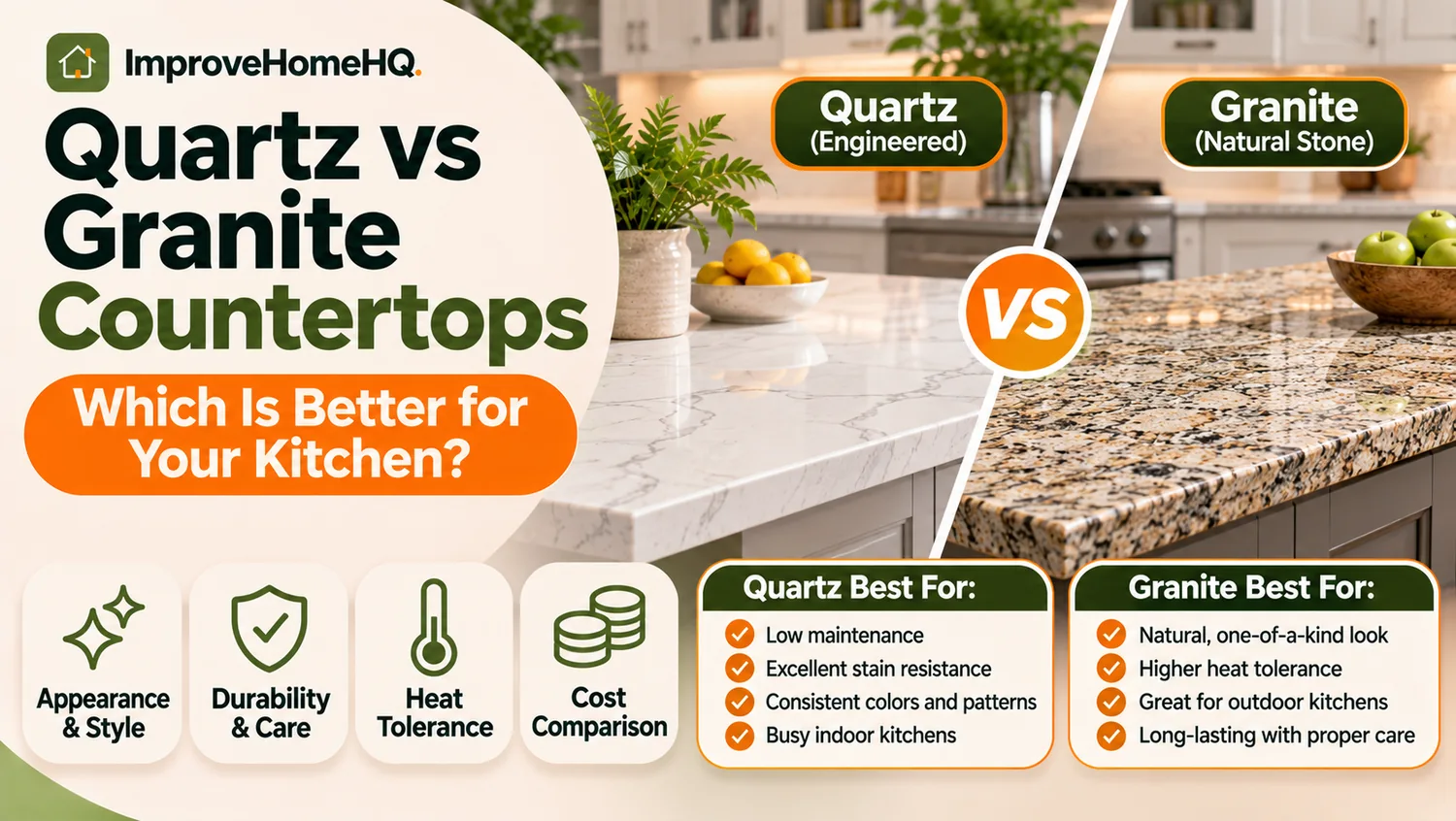
Quartz vs Granite Countertops: Which Is Better for Your Kitchen?
Quick answer: Quartz is usually the better choice if you want a low-maintenance kitchen countertop with consistent colors and strong stain resistance. Granite is better if you prefer a one-of-a-kind natural stone surface, want greater heat tolerance, or are planning an outdoor kitchen. Both can last for decades when properly installed and cared for. Neither is scratchproof, chip-proof, or completely maintenance-free. Compare actual slabs and installed quotes before deciding.
Choosing a countertop is about more than picking a color. The surface needs to handle hot cookware, coffee spills, food prep, cleaning products, and years of everyday use. Quartz and granite are both strong candidates, but their strengths aren’t identical.
The biggest difference is simple: granite is natural stone; quartz countertops are manufactured surfaces. That affects how they look, how they handle heat and stains, and what upkeep they need. Here’s how to decide which fits your kitchen, budget, and habits.
Quartz vs Granite: At-a-Glance Comparison
| Feature | Quartz countertops | Granite countertops |
|---|---|---|
| Material | Engineered surface made from mineral particles, binders, and pigments | Natural stone cut into slabs |
| Appearance | More predictable patterns; many marble-look options | Unique mineral patterns and movement in every slab |
| Stain resistance | Generally excellent; nonporous surface | Good to excellent, depending on the stone and treatment |
| Heat tolerance | Lower; hot pans and heated appliances can damage the binder | Generally higher, though thermal shock is still possible |
| Scratch resistance | Good, not scratchproof | Good, not scratchproof |
| Sealing | Not required for typical engineered quartz | Depends on the slab; not all granite requires sealing |
| Routine cleaning | Mild soap, water, soft cloth | Mild soap, water, stone-compatible cleaner |
| Direct sunlight/outdoors | Standard indoor quartz may discolor or deteriorate | Generally the better candidate for outdoor exposure |
| Installed price | Roughly 50–200 per sq. ft. | Roughly 80–150 per sq. ft. |
| Best for | Busy indoor kitchens, predictable design, minimal upkeep | Natural-stone character, heat-focused cooking, outdoor counters |
Prices are broad U.S. planning ranges, not guaranteed quotes. Region, slab selection, layout, labor, and add-ons can change the final bill significantly.
What Is the Difference Between Quartz and Granite?
What is a quartz countertop made of?
A typical engineered quartz countertop combines mineral particles—including quartz—with resins, pigments, and sometimes recycled materials. Manufacturers form the mixture into slabs, producing a dense surface with controlled colors and patterns.
Although the name sounds natural, engineered quartz is not a solid slab quarried from the earth. Its mineral content and binder formulation vary by product, so claims that every quartz countertop contains an exact percentage of quartz are misleading. Check the technical specifications for the particular line you’re considering.
Because the surface is nonporous, it does not need a penetrating stone sealer. Brands such as Cambria, Caesarstone, Silestone, and MSI offer different looks, finishes, and warranty terms. Those product details—not just the word quartz—matter when comparing slabs.
What is granite?
Granite is an igneous rock formed as molten material cools below Earth’s surface. Its visible crystals typically include quartz, feldspar, and mica. Slabs are quarried, cut, finished, and fabricated to fit a kitchen.
Every piece differs in color, mineral distribution, veining, and movement. Even two slabs of the same named variety can look noticeably different. Some commercial stones sold as “granite” are technically other rock types, so ask the supplier about the specific material if its properties concern you.
Granite is often described as porous, but its absorbency varies considerably. Some dense varieties resist staining well without additional treatment; others benefit from a suitable impregnating sealer.
Quartz vs Granite Cost: Which Is More Affordable?
Neither material is automatically the cheaper option. Common granite patterns can cost less than premium quartz, while rare or dramatic granite slabs can exceed many quartz designs.
As a starting point for U.S. budgeting, quartz often runs about 50–200 per square foot installed, and granite about 80–150 per square foot installed. These are broad published estimates, not local market averages or prices for every product.
For example, a kitchen with 40 square feet of countertop surface might have a rough material-and-installation allowance of:
| Countertop | Illustrative installed budget for 40 sq. ft. |
|---|---|
| Quartz | 2,000–8,000 |
| Granite | 3,200–6,000 |
The wide ranges overlap. A $3,500 granite quote could be a better value than a $5,500 quartz quote—or vice versa—depending on the exact material and work included.
What changes the installed price?
- Slab choice and availability: Exotic colors, dramatic veining, and special-order materials may cost more.
- Thickness: Common nominal options are 2 cm and 3 cm; installation and edge details can differ.
- Kitchen layout: L-shaped counters, large islands, corners, and multiple pieces affect fabrication.
- Cutouts: Sinks, faucets, cooktops, and outlets increase precision work.
- Edge profile: Straight or eased edges are often simpler than ornate profiles.
- Seams and slab yield: Pattern matching and waste can raise costs, especially with heavily veined surfaces.
- Removal and preparation: Old-countertop disposal, cabinet leveling, reinforcement, plumbing, and backsplash work may be extra.
Buying tip: Request at least three itemized, installed estimates for comparable slabs. Ask whether templating, delivery, cutouts, sink mounting, edge finishing, sealing if needed, teardown, and cleanup are included. Comparing slab-only prices can lead to an unpleasant surprise.
Which Countertop Is More Durable?
Both are suitable for a busy family kitchen and can remain attractive for decades. But durability isn’t one single quality: a countertop may resist stains while still being vulnerable to heat or edge impacts.
Scratches and chips
Quartz and granite both resist normal wear better than many softer countertop materials. Neither should be used as a cutting board. Knives can be dulled, and grit, ceramic objects, or sharp impacts may leave marks.
The most vulnerable areas are often sink openings, inside corners, and exposed edges. A heavy cast-iron pan dropped on an edge can chip either material. A chipped quartz surface may require a color-matched repair; damaged granite can also require professional filling and finishing.
Good fabrication matters as much as the material. Proper support, careful cutout placement, and appropriately rounded inside corners help reduce stress points.
Stains and spills
Quartz generally has the easier stain-resistance story. Its nonporous surface doesn’t need sealing and usually handles everyday spills well when cleaned promptly. Still, prolonged contact with dyes, certain chemicals, adhesives, or other difficult substances can leave discoloration or residue.
Granite can also resist staining very well, particularly when the slab is dense or correctly treated. However, oil, wine, and other liquids may penetrate some types if left sitting. Ask the stone supplier about the absorbency and sealing recommendations for your exact slab.
Heat resistance: where granite has an advantage
Granite generally tolerates heat better because it does not rely on the same polymer binder used in standard engineered quartz. Even so, don’t make a habit of placing extremely hot cookware directly on granite. Sudden temperature changes can damage stone or contribute to cracks, particularly near weak spots and cutouts.
For quartz, the rule is firmer: always use a trivet or heat pad under hot pots, roasting pans, air fryers, electric griddles, slow cookers, and similar appliances. Direct or prolonged heating can discolor the resin or cause thermal stress. Manufacturer guidance from Cambria specifically warns against direct heat transfer from cookware and countertop appliances.
Avoid relying on a single claimed “maximum safe temperature.” Limits vary across products, duration, and conditions. Follow the instructions for the exact brand you buy.
Maintenance and Cleaning: Which Is Easier to Live With?
For most households, quartz wins on routine maintenance because it doesn’t require sealing. Granite isn’t difficult to care for, but its treatment needs should be checked rather than assumed.
How to clean quartz countertops
- Wipe crumbs and spills with a soft cloth or nonabrasive sponge.
- Clean with warm water and a little mild dish soap.
- Rinse off soap residue and dry with a clean cloth.
- For persistent marks, use only a cleaner approved by the slab manufacturer.
Avoid abrasive pads, aggressive solvents, and harsh cleaners unless the manufacturer specifically permits them. Some chemicals can permanently alter the finish.
How to clean granite countertops
- Remove grit that could scratch the finish.
- Wipe with warm water, mild dish soap, or a granite-safe cleaner.
- Dry the counter and promptly clean oily or deeply colored spills.
- Ask your fabricator whether the slab needs sealer and how to recognize when reapplication is appropriate.
Don’t routinely clean granite with vinegar or other acidic solutions; they may affect treatments and certain stone components. Bleach or abrasive products can also create problems.
Does granite need sealing every year?
Not necessarily. Blanket advice to seal all granite annually is outdated. The Natural Stone Institute says many granite countertops do not require sealing, though sealing can improve moisture and oil resistance for some stones. The suitable treatment and interval depend on the actual stone, finish, prior factory treatment, sealer chemistry, and exposure.
If water quickly darkens an inconspicuous area of your slab, ask a stone professional whether its protective treatment needs attention. Don’t apply a sealer blindly: an unsuitable product or excess residue can leave a haze. See the Natural Stone Institute’s guidance on sealing natural stone.
Appearance and Design: Natural Variation or Consistency?
Choose quartz if you want a repeatable, coordinated look. Many engineered designs mimic white marble, soft gray veining, or understated concrete. Quartz can be particularly useful when you need multiple counters with similar patterns, although actual slab batches and vein placement still vary.
Choose granite if you want natural variation. Mineral crystals, flecks, waves, and occasional dramatic movement give each piece its own character. Some homeowners love that unpredictability; others prefer tighter color control.
Before deciding, view full slabs in person, not just small samples or website photos. Check them under light similar to your kitchen’s. This matters especially with large islands, waterfalls, full-height backsplashes, and adjoining countertop sections where pattern direction is obvious.
Finishes, edges, and seams
Both materials come in polished and various matte or textured finishes, depending on the supplier. A polished finish reflects more light, while a honed or matte finish can make fingerprints or surface marks show differently. Ask to see a used display sample, not only a pristine new piece.
Seams are sometimes unavoidable with large layouts. For quartz, ask how the printed or engineered vein pattern will continue across the join. For granite, arrange slabs side by side and approve how their natural movement lines up. Edge choices such as eased, beveled, bullnose, and mitered waterfall details affect appearance and fabrication cost.
Quartz vs Granite for Different Spaces
Busy family kitchen
Quartz often makes more sense when spills are frequent and you want to skip sealing decisions. Its predictable appearance also makes cabinet, tile, and backsplash coordination easier. Use heat pads and cutting boards, and it should handle normal indoor kitchen life well.
Kitchen for frequent high-heat cooking
Granite may be the more forgiving surface around hot cookware, but heat pads remain good practice. If you frequently use countertop appliances that give off sustained heat, follow the manufacturer’s clearance and surface-protection instructions regardless of your countertop choice.
Bathroom vanity
Both work. Quartz is convenient around cosmetics, toothpaste, and regular cleaning because it is nonporous. Granite offers distinctive color and texture, but some varieties may need extra attention around oils and dyes.
Outdoor kitchen or sunny location
Granite is generally the safer default for an uncovered outdoor kitchen. Ordinary indoor quartz can be affected by ultraviolet light and weather, and many products are not warranted for outdoor installation. If you prefer an engineered surface, select one explicitly rated by its manufacturer for outdoor use and the local climate.
Safety and Environmental Considerations
Is quartz dangerous because of silica?
The most serious documented silica risk concerns workers who cut, grind, polish, or drill stone countertops, not people simply using an intact installed countertop. Such work can generate respirable crystalline silica dust, which can cause silicosis and other serious diseases. Granite fabrication can create hazardous dust too; many traditional engineered-quartz products contain especially high levels of crystalline silica.
OSHA has specifically addressed hazards in stone fabrication and installation. Its recommendations include effective wet methods, local exhaust ventilation, appropriate respiratory protection where required, and other controls. Do not dry-cut or grind either countertop in your home. If an installer must modify a slab on-site, ask how dust will be controlled and whether fabrication can be completed at the shop instead. For details, consult OSHA’s engineered-stone silica guidance.
An intact installed engineered-quartz surface does not normally create the airborne silica dust associated with cutting operations. This is different from claiming that all countertop products or all installation practices are risk-free.
Which material is more environmentally friendly?
There isn’t a universal winner. Granite must be quarried, cut, and transported, sometimes over long distances. Quartz requires mined or sourced minerals, industrial processing, binders, and transport. Some engineered products incorporate recycled content; some manufacturers publish environmental product declarations or other verified impact data.
If sustainability is a deciding factor, compare product-specific documentation, fabrication waste, transport distance, durability, and whether the slab can remain in service during future renovations. Don’t assume “natural” automatically means lower-impact or “engineered” automatically means greener.
Pros and Cons of Quartz Countertops
Pros
- No routine sealing required.
- Strong everyday stain resistance.
- Broad range of colors and relatively consistent patterns.
- Easy daily cleanup.
- Suitable for most indoor kitchens and bathrooms.
Cons
- Vulnerable to direct or sustained high heat.
- Standard indoor products may be unsuitable outdoors.
- Can chip, scratch, or discolor under certain conditions.
- Some styles cost as much as or more than premium granite.
- Fabrication of silica-containing products poses serious occupational hazards without adequate controls.
Pros and Cons of Granite Countertops
Pros
- Naturally unique slabs and mineral patterns.
- Generally better heat tolerance than engineered quartz.
- Strong scratch and wear resistance in typical kitchen use.
- Good choice for many outdoor installations.
- Common varieties can be competitively priced.
Cons
- Slab-to-slab variation can complicate matching.
- Some stones need sealing or other protective treatment.
- Certain slabs can absorb oil or colored liquids.
- Chips and cracks are still possible.
- Heavy slabs require careful handling, supported cabinetry, and professional fabrication.
How to Choose Between Quartz and Granite
Use these questions at a slab showroom or during an estimate:
- What bothers you more: extra upkeep or using trivets? Quartz minimizes sealing concerns; granite offers greater heat tolerance.
- Do you want consistent veining or a one-off natural pattern? View full slabs before answering.
- Where is the counter going? Indoor kitchens suit both; outdoor exposure favors appropriately selected granite.
- What exactly is covered by the quote? Compare installed totals, not square-foot material prices alone.
- What are the care and warranty restrictions? Request the actual manufacturer’s written instructions.
- How will the installer handle seams, supports, and silica dust? Ask before fabrication begins.
Also check that your cabinets are sound and level, especially near dishwashers, sink spans, unsupported overhangs, and large island cutouts. Ask the fabricator what brackets or reinforcement are required. Both materials are heavy, and neither should be treated as a structural shelf without engineered support.
Common Mistakes to Avoid
- Assuming quartz is heatproof. Heat resistance is not the same as permission to set down a hot pan.
- Assuming every granite slab must be sealed annually. Check the actual stone and treatment.
- Shopping from tiny samples only. Full-slab movement and veining may look completely different.
- Ignoring seam placement. A poorly placed seam or mismatched vein can dominate a finished island.
- Comparing incomplete prices. Sink cutouts, removal, transport, and edge upgrades change the total.
- Treating “stain resistant” as “stainproof.” Prompt cleanup remains the safest routine for either surface.
- Accepting uncontrolled dry cutting. Silica-dust control is a real fabrication and installation issue.
Frequently Asked Questions
Is quartz better than granite for kitchen countertops?
Quartz is often better for homeowners who prioritize easy cleaning, stain resistance, and a predictable design. Granite is often better for people who want natural stone, more heat tolerance, or an outdoor counter. The better choice depends on how you cook and what look you prefer.
Which lasts longer, quartz or granite?
Both can last for decades with proper support, installation, and care. Neither has a guaranteed lifespan that applies to every slab and household. Avoiding impacts, heat damage, and inappropriate cleaners will matter more than a blanket longevity claim.
Which stains more easily?
Quartz generally resists absorbing spills better because it is nonporous. Granite absorbency varies by stone and surface treatment. Neither material is immune to all stains or discoloration.
Can you put hot pans on granite or quartz?
Use a trivet for both. Granite usually handles heat better, but rapid temperature changes can still damage stone. Direct heat can damage the resin in standard engineered quartz, so hot cookware and heat-producing appliances should always be protected.
Does quartz need to be sealed?
No. Typical engineered quartz is nonporous and does not require penetrating stone sealers. Adding sealer unnecessarily may leave residue; follow the brand’s care instructions.
Does granite have to be sealed?
Not always. Many granite countertops perform well without sealing, while some benefit from it. Ask about the selected slab’s absorbency, factory treatment, and the recommended sealer rather than following an arbitrary annual schedule.
Is granite cheaper than quartz?
Sometimes. Basic granite may be cheaper than premium quartz, but uncommon granite patterns can cost substantially more. Get comparable installed quotes for the actual slabs you like.
Is quartz the same as quartzite?
No. Quartz countertops are engineered surfaces made with mineral particles and binders. Quartzite is a naturally occurring metamorphic rock, typically sold as stone slabs. Its care and sealing needs are closer to other natural stones and vary by slab.
Are quartz countertops safe once installed?
An intact installed countertop does not normally create the respirable crystalline silica dust generated by cutting or grinding. The major documented concern is occupational exposure during fabrication and modification. Avoid any uncontrolled on-site cutting of stone.
Which countertop adds more resale value?
Both are recognized premium countertop materials. Neither guarantees a specific return on investment. A well-executed kitchen design, appropriate pricing for the neighborhood, and the overall condition of the home usually matter more than the difference between these two surfaces.
Final Verdict: Which Should You Buy?
For a typical indoor kitchen, quartz is the practical default if you value easy cleanup and a design you can match across multiple surfaces. Granite is an equally credible choice if the natural slab is what you love, you want better heat tolerance, or your project includes an outdoor counter.
Don’t choose on a label alone. Visit a slab yard, examine the exact material under good lighting, review written care instructions, and compare itemized installation quotes. The best countertop is the one that fits your cooking habits, your design, and your budget—not the one advertised as universally superior.