Quartz vs Quartzite Countertops: Which Is Better for Your Kitchen?
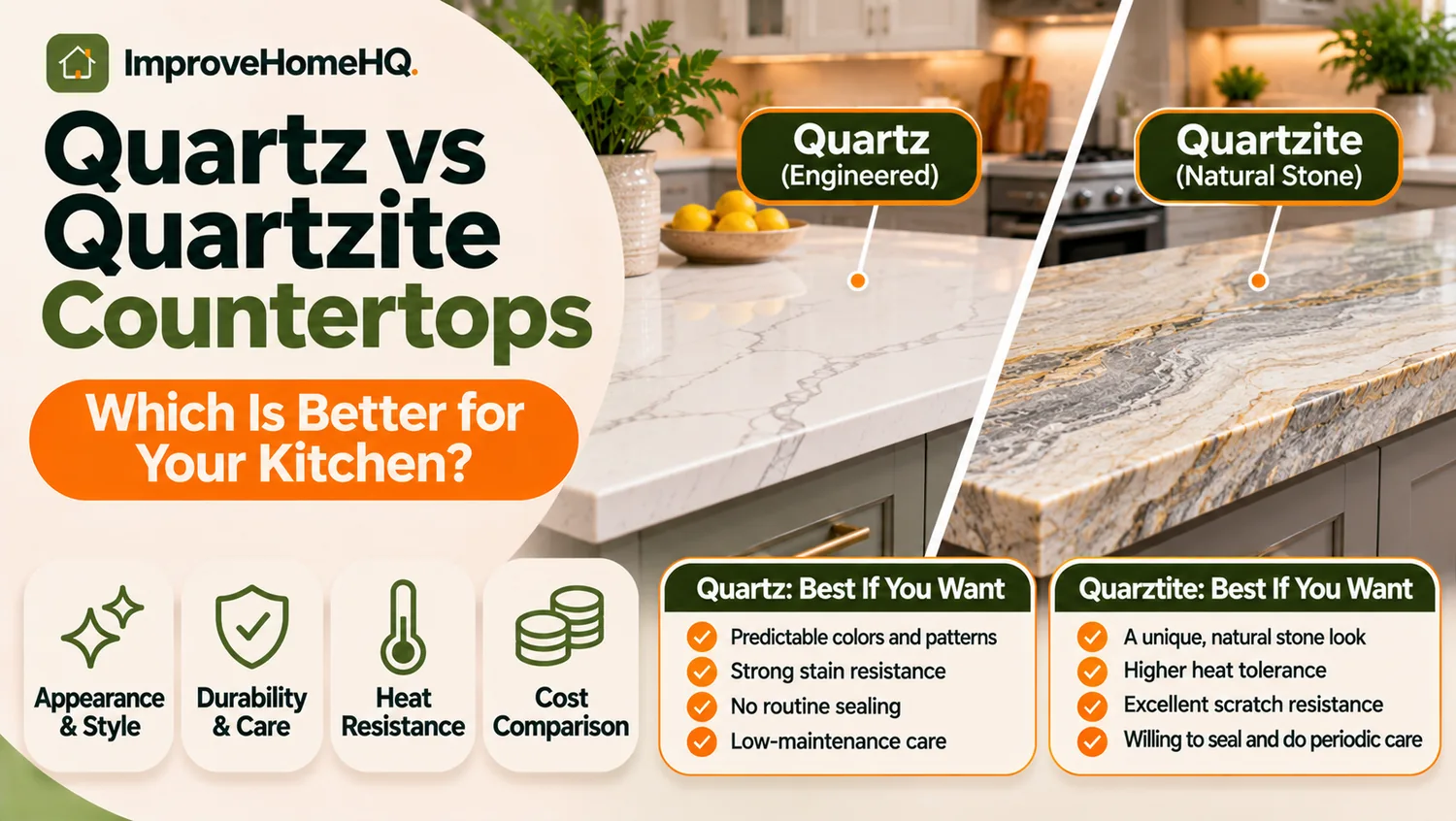
Quick answer: Quartz is an engineered countertop made with minerals, pigments, and binders. Quartzite is a natural stone formed when sandstone changes under heat and pressure. Choose quartz if you want predictable patterns, good stain resistance, and no routine sealing. Choose quartzite if you prefer distinctive natural veining and greater heat tolerance and are willing to maintain a stone surface. Both can chip, scratch, or suffer damage, and the right choice depends on the specific product or slab.
The names sound almost identical, but the countertops behave differently. A kitchen with frequent spills, busy family meals, and minimal time for maintenance has different needs from one built around a dramatic natural-stone island.
Before choosing, compare the surfaces you can actually purchase—not just attractive showroom photos. The finish, stone type, manufacturer instructions, and installation quality matter as much as the material category.
Quartz vs Quartzite: Differences at a Glance
| Feature | Quartz countertops | Quartzite countertops |
|---|---|---|
| Material | Manufactured surface made from minerals and binders | Natural metamorphic stone, principally quartz |
| Appearance | Wide range of controlled colors and patterns | One-of-a-kind movement, veining, and mineral variation |
| Stain resistance | Generally strong; no routine sealing | Varies by slab and finish; sealing often recommended |
| Heat resistance | Resin components can be damaged by hot cookware | Natural stone generally tolerates more heat; trivets still advised |
| Scratch resistance | Good, but not scratchproof | True quartzite is highly scratch resistant; finish and inclusions vary |
| Chips and cracks | Possible, especially around edges and cutouts | Possible, particularly along vulnerable edges or natural fissures |
| Everyday cleaning | Mild soap, water, and a soft cloth | Mild soap or pH-neutral stone cleaner and a soft cloth |
| Outdoor applications | Many conventional resin-bound products are not approved for prolonged UV exposure | Often suitable, subject to climate, finish, and fabricator guidance |
| Design consistency | Easier to coordinate across multiple pieces | Must inspect and plan around variation in actual slabs |
| Main trade-off | Easier routine upkeep, less heat tolerance | Natural beauty and heat tolerance, more variable upkeep |
Bottom line: Quartz is usually the easier everyday-care choice. Quartzite is often the more distinctive natural-stone choice. Neither is indestructible.
What Is the Difference Between Quartz and Quartzite?
What is engineered quartz?
A quartz countertop is a factory-made slab. Manufacturers combine quartz or other mineral particles with binding materials and pigments, then form and finish the surface. The exact ingredients and mineral content vary by product; not every modern engineered surface has the same formula.
The controlled manufacturing process makes it possible to create subtle solid colors, dramatic marble-inspired veins, or repeated patterns with relatively predictable results. Familiar U.S. countertop brands include Cambria, Caesarstone, Silestone, and MSI’s Q Premium Natural Quartz. Each offers different collections, finishes, care requirements, and warranties.
The word quartz also describes a naturally occurring mineral. When a kitchen showroom says “quartz countertops,” however, it generally means an engineered surface—not a slab of pure natural quartz.
What is natural quartzite?
Quartzite is a metamorphic rock formed when quartz-rich sandstone undergoes geological heat and pressure. As quartz grains recrystallize, they form a dense, interlocking structure.
Natural slabs may feature cream, white, gray, gold, or green tones, with patterns created by mineral impurities and geological processes. Some have gentle movement; others feature dramatic bands or translucent sections. Popular trade names include Taj Mahal and Mont Blanc, although naming conventions and material classifications can vary by seller.
True quartzite is notably hard. But a showroom label is not a laboratory identification: some softer stones and quartz-rich sandstones have been marketed under the quartzite name. That distinction affects scratching, acid sensitivity, and care.
Appearance: Natural Character or Consistent Patterns?
The biggest visual difference is uniqueness versus predictability.
Quartzite appeals to homeowners who want a slab that looks like no other. Veins may change direction across an island, and color can shift from one end to the other. If you want a prominent statement piece, that natural movement may be the reason to buy it.
Quartz offers more control. You can choose from understated speckles, warm white backgrounds, charcoal finishes, and patterns designed to resemble natural marble or quartzite. This is useful when matching a large island to perimeter counters or when installing countertops in several rooms.
Neither material guarantees invisible seams. Seams depend on slab dimensions, layout, pattern direction, color, lighting, and the installer’s skill. Highly directional veining requires careful seam planning in either material.
Shopping tip: For quartzite, photograph and approve the actual slabs, including their orientation and where sink and cooktop cutouts will fall. For quartz, inspect a full-size display or large sample: a tiny sample may not represent the scale of the finished pattern.
Durability: Scratches, Chips, Stains, and Heat
Which surface resists scratches better?
Both materials work well in active kitchens, but neither should be treated as a cutting board.
True quartzite is made primarily of quartz, a mineral with a Mohs hardness of about 7. That gives sound quartzite excellent resistance to many everyday scratches. However, softer mineral inclusions, fissures, finishes, and misidentified stone can affect real-world performance.
Engineered quartz also has good scratch resistance, but resins and the finished surface can be marked by abrasive pads, dragged pottery, or gritty debris. Cutting directly on either counter risks dulling a knife, marking the surface, or damaging a vulnerable edge.
Best practice: Use a cutting board, lift heavy cookware instead of sliding it, and keep sand or grit off the countertop.
Which is more stain resistant?
For routine spills, engineered quartz generally has the advantage. Its low-absorption surface does not typically need a penetrating stone sealer. Still, “stain resistant” does not mean stainproof: dyes, certain chemicals, persistent residues, or extended contact with problem substances may leave marks depending on the product.
Quartzite is more variable. Some slabs absorb little liquid; others darken or stain more easily, especially around edges, seams, or areas with natural fissures. A suitable penetrating sealer can reduce absorption, but it does not make a counter waterproof or eliminate the need to clean spills.
Coffee, wine, oil, tomato sauce, and brightly colored ingredients are all worth wiping up promptly. Ask the stone supplier whether the specific quartzite slab needs sealing and how to recognize when protection has worn off.
Is quartzite more heat resistant than quartz?
Generally, yes. Quartzite’s mineral structure tolerates heat better than the polymer binders found in many engineered quartz products. Very hot pans can discolor, scorch, or otherwise damage the resin in quartz.
That does not make quartzite a safe place to set every hot skillet. Extreme temperature changes can stress stone, affect resins used in some slab repairs or treatments, and compromise existing weak spots. Both materials can be damaged by thermal shock or by a concentrated heat source.
Use a trivet or heat pad under cookware, countertop appliances that radiate heat, and anything brought directly from the oven. Avoid relying on a universal temperature limit: tolerances differ by product, exposure time, and installation conditions.
Can either countertop chip or crack?
Yes. Both can chip when struck by heavy objects, especially near sink openings, corners, and exposed edges. A heavy cast-iron pan dropped onto an edge can damage either surface.
A skilled fabricator may be able to repair small chips using appropriate fillers and color matching. Repairs on heavily patterned stone can be more noticeable. Cracks near cutouts can also indicate inadequate support or installation stress rather than a defective material.
Discuss sink support, dishwasher clearances, overhang reinforcement, and edge profiles before fabrication. A gently rounded edge may be less vulnerable to impact than a sharp, square corner.
Maintenance: What Living With Each Countertop Is Really Like
How to clean quartz countertops
- Wipe crumbs and grit away with a soft cloth.
- Use warm water and a little mild dish soap for everyday cleaning.
- Rinse away soap residue and dry the surface to limit streaks.
- Address stubborn marks only with a cleaner approved by the surface manufacturer.
Avoid abrasive scouring pads, aggressive solvents, and cleaners that the warranty or product care guide prohibits. Quartz generally does not need sealing, polishing treatments, or wax to remain functional.
How to clean and seal quartzite countertops
- Remove grit before wiping to avoid grinding it across the finish.
- Clean with a soft cloth and mild dish soap or a pH-neutral cleaner intended for natural stone.
- Dry the surface and clean colored or oily spills promptly.
- Follow the fabricator’s advice on a compatible impregnating sealer and reapplication intervals.
There is no reliable single resealing schedule for every quartzite. Absorption depends on the actual stone, finish, usage, and sealer. Some slabs may need more frequent attention than others; some are naturally very dense.
A small water-drop observation in an inconspicuous area may indicate absorption, but it does not replace the fabricator’s assessment. Ask before applying a new sealer over a factory treatment or existing coating.
One common misunderstanding: A sealer helps resist staining, not scratching or acid damage. If a surface marketed as quartzite etches readily from lemon juice, its mineral composition may deserve closer examination.
Quartz vs Quartzite Cost: What Changes the Price?
Both are premium countertop categories, and installed prices overlap. Natural quartzite often costs more at the higher end because of slab rarity, sourcing, intricate vein matching, and additional fabrication work. High-end designer quartz can also cost more than common quartzite selections.
Published national figures are only rough budgeting references. For example, Lowe’s has listed installed ranges of approximately 60–150 per square foot for quartz and 65–190 per square foot for quartzite. These are indicative figures from its buying guide, not live local quotes, and a specialty slab can exceed them.
For a hypothetical 40-square-foot countertop job, those illustrative ranges imply roughly 2,400–6,000 for quartz or 2,600–7,600 for quartzite. Your actual bid may differ considerably because suppliers price whole slabs, and small projects may have minimum charges.
Request written estimates that specify:
- Exact slab or product name, thickness, finish, and amount of material.
- Number and placement of seams, including any vein matching.
- Sink and cooktop cutouts, edge fabrication, and backsplash work.
- Removal and disposal of existing counters.
- Reinforcement, plumbing disconnect/reconnect, and any cabinet preparation.
- Delivery, installation, sealing, taxes, warranty, and possible change orders.
Compare the complete installed total, not just a per-square-foot advertisement. An unusually low quote can exclude details that become expensive later.
Pros and Cons of Each Material
Quartz: advantages and drawbacks
Advantages
- No routine sealing for most engineered quartz surfaces.
- Good resistance to everyday food and drink spills.
- Broad choice of colors, including controlled marble-like patterns.
- Easier coordination when multiple slabs are needed.
- Straightforward cleaning for busy households.
Drawbacks
- Hot cookware can damage the binder or finish.
- Many conventional products are unsuitable for unprotected outdoor exposure.
- Not immune to chips, scratches, or stubborn staining.
- Manufactured patterns may appear less natural to some buyers.
Quartzite: advantages and drawbacks
Advantages
- Unique, naturally formed coloration and veining.
- Excellent scratch resistance when the slab is true, sound quartzite.
- Generally greater heat tolerance than resin-bound quartz.
- Potential for exterior use when the specific stone and climate are suitable.
Drawbacks
- Stain resistance and sealing requirements vary by slab.
- Natural movement complicates matching, seam placement, and replacements.
- Some slabs require specialist handling or added fabrication time.
- Mislabeling can cause buyers to purchase a softer or more acid-sensitive stone than expected.
How to Check That You Are Buying Genuine Quartzite
This is one of the most valuable checks you can make before committing to an expensive natural-stone surface.
First, ask for the stone’s geological identification. The sales name alone may not be enough. A reputable supplier should be willing to discuss whether it is true quartzite, quartzitic sandstone, marble, or another material.
Second, request an offcut from the actual slab. With the supplier’s permission, a professional can evaluate scratch resistance and reactions to a mild acid on an expendable sample. True quartzite is generally hard enough to scratch glass, while calcite-rich marble can react to acids. These tests are informative but not definitive; coatings, mixed mineral zones, and stone variation can complicate interpretation. Never conduct destructive tests on a display or purchased slab without permission.
Third, ask about absorption, resin treatments, and sealing. Some natural slabs are treated during production. Knowing what has been applied helps prevent incompatible maintenance products later.
Finally, inspect the complete slab in good light. Look for existing fissures, filled areas, and features that might fall near a sink cutout or unsupported overhang. Natural features are not automatically defects, but you should understand them before approving the fabrication layout.
For more background on the geological distinctions and identification problems, see the Natural Stone Institute’s educational guide.
Which Countertop Is Better for Your Kitchen?
For families with young children
Quartz is often the simpler choice. Its low-absorption surface is forgiving when juice, sauces, and snacks are part of daily life, and you do not need to keep up with a sealing schedule. However, a properly selected and sealed quartzite can also perform well in an active family kitchen. The difference is the amount of attention you are willing to give spills and care instructions.
For people who cook frequently
If you use heavy pots and handle hot cookware regularly, quartzite offers an advantage in heat tolerance. You should still use trivets and protect edges. If your biggest challenge is constant cleanup rather than hot pans, quartz may be more convenient.
For a luxury kitchen island
Quartzite can be a striking centerpiece, especially when a full slab’s natural veining is laid out deliberately. Budget for viewing the slab in person and planning seams carefully. If you prefer a sophisticated but repeatable design across a large kitchen, premium quartz is also worth considering.
For bathrooms and vanities
Both can work well. Quartz’s low-maintenance surface makes it attractive around toothpaste, cosmetics, and splashing water. Quartzite offers a natural-stone look but needs thoughtful protection against staining and potentially damaging products. Check the finish and cleaner compatibility for either surface.
For outdoor kitchens
Natural quartzite may be an option, but confirm freeze-thaw suitability, water absorption, finish performance, and regional climate with an experienced stone supplier. Many standard engineered quartz countertops are not approved for prolonged direct sunlight because UV exposure can affect the resin and color. Do not assume an “outdoor quartz” product has the same formulation as regular indoor quartz; check its written specifications.
Installation and Safety: Why the Fabricator Matters
Both materials are heavy and require accurate templating, cutting, handling, and support. Installation is usually a professional job, not a casual DIY project.
There is also a serious worker-safety issue that should not be overlooked. Cutting, grinding, or polishing silica-containing countertop materials can release respirable crystalline silica dust. Exposure can cause silicosis and other serious lung disease. Quartzite and many engineered quartz products can contain high levels of crystalline silica, although engineered products vary in composition.
A qualified fabricator should use appropriate engineering controls, dust-management practices, respiratory protection where required, and applicable workplace procedures. Do not dry-cut or grind countertop slabs at home. Choosing natural stone instead of engineered stone does not eliminate silica-dust risk.
The U.S. Occupational Safety and Health Administration provides detailed guidance on silica exposure during countertop manufacturing and installation.
Ask the installer whether the bid includes safe fabrication practices, adequate structural support, a written seam plan, and appropriate warranty coverage. Those details influence how the countertop performs for years after installation.
Common Mistakes to Avoid Before Ordering
- Choosing by name alone. Confirm whether you are buying engineered quartz, true quartzite, or another stone sold under a similar trade name.
- Assuming heat resistance means heatproof. Use trivets with both materials.
- Believing “nonporous” means stainproof. Clean prolonged spills and follow the manufacturer’s product-specific instructions.
- Treating every quartzite slab the same. Ask about absorption, finishes, sealing, fissures, and existing treatments.
- Ordering natural stone from a tiny sample. Approve the actual slabs and the fabrication layout.
- Comparing material-only prices. Evaluate the final installed cost and all exclusions.
- Ignoring care and warranty documents. Get instructions in writing before using strong cleaning chemicals or applying sealers.
Frequently Asked Questions
Is quartzite better than quartz?
Neither is universally better. Quartz is typically easier to maintain and offers more predictable patterns. Quartzite provides unique natural beauty and usually greater heat tolerance. The best option depends on how you cook, your design goals, and the characteristics of the actual slab or product.
Does quartzite stain more easily than quartz?
Often, yes, because some quartzites absorb liquids and may require sealing. But absorption varies significantly between stones. Engineered quartz generally resists everyday staining well without sealing, though it is not completely stainproof.
Does quartzite need to be sealed every year?
Not necessarily. Some quartzites need periodic sealing, but there is no universal annual rule. The stone’s absorption, finish, sealer, and usage determine how frequently resealing is appropriate. Follow the fabricator’s instructions for the specific slab.
Can I put a hot pan directly on quartzite?
It’s better not to. Quartzite generally withstands heat better than engineered quartz, but thermal shock, vulnerable areas, and any applied treatments can still be affected. A trivet is the safer everyday habit.
Is quartzite harder than granite?
True quartzite is composed mainly of hard quartz and can offer excellent scratch resistance. Granite contains several minerals with different hardness values, so there is no single performance result for all granite or quartzite slabs. Compare the actual stone rather than relying on a blanket ranking.
Will quartz look like real quartzite?
Some engineered quartz collections convincingly imitate quartzite’s soft colors and veining, particularly when viewed across a finished installation. Real quartzite still has naturally occurring movement and depth that may be difficult to reproduce exactly. Inspect large samples of both before deciding.
Which countertop lasts longer?
Both can last for decades when properly supported, installed, and maintained. There is no credible universal lifespan that makes one the winner in every kitchen. Impact damage, heat exposure, cleaning habits, and installation quality often matter more than marketing claims about lifetime durability.
Is quartzite the same as marble?
No. True quartzite is mainly quartz and is generally much harder and more acid resistant than calcite-rich marble. Because some stones are mislabeled in the marketplace, ask for geological identification and appropriate sample testing before purchasing.
Final Verdict
Choose quartz when you want an attractive countertop with predictable design options, good everyday stain resistance, and no routine sealing. It is a practical fit for many busy U.S. kitchens.
Choose quartzite when natural veining, one-of-a-kind character, and higher heat tolerance matter more—and you are comfortable learning the care needs of your specific slab.
Before signing, compare full-size materials, ask for written maintenance instructions, review the installed quote, and work with a fabricator familiar with the surface you’ve chosen. A well-selected, properly installed countertop is a better investment than a material chosen on reputation alone.