How to Remove Water Stains From Wood Without Damaging the Finish
Quick answer: To remove a white water ring from finished wood, wipe the area dry, let it air out, then try a hair dryer on low heat while keeping it moving. If the mark remains, a small amount of petroleum jelly may help conceal or reduce it on a compatible finish. Dark brown or black stains usually extend into the wood and may require stripping, treatment with oxalic acid wood bleach, and refinishing. Always test in a hidden area first. Avoid heat and DIY chemical treatments on antiques, valuable furniture, and finishes you cannot identify.
A cold glass leaves a cloudy circle on the coffee table. A damp plant pot creates a dark patch on a windowsill. Both are called water stains, but they aren’t the same problem—and treating them as if they are can damage an otherwise sound finish.
The right fix depends on the color of the mark, the type of finish, and how long moisture was present. Start with the least aggressive approach. Many white rings can improve without sanding; black marks often need a repair below the finish.
First, Identify the Water Stain
Examine the area in good light and run a clean, dry fingertip lightly across it. Don’t scrape or pick at a raised coating.
| What you see | Likely cause | Best first step |
|---|---|---|
| White ring or milky haze | Moisture trapped in or affecting a clear finish | Dry naturally, then consider gentle warmth |
| Dark brown or black ring | Water reached the wood; discoloration may involve tannins, iron, or other reactions | Check for an ongoing leak, then assess refinishing |
| Raised grain or rough patch | Water swelled exposed wood fibers | Dry fully; assess the finish before any sanding |
| Bubbling, peeling, or lifting veneer | Water affected the coating or adhesive | Stop home remedies; consider a furniture repair specialist |
| Sticky, softened, or discolored finish | Heat, cleaners, or moisture damaged the finish itself | Stop rubbing; identify the finish before repair |
This white-versus-dark distinction is supported by wood-finishing manufacturer General Finishes, which notes that white rings typically occur in the finish and dark rings indicate staining in the wood.
Before you begin: Check the furniture maker’s care instructions. Some modern coatings tolerate cleaning and moderate warmth better than shellac, lacquer, wax, oil, or an aged finish. No home remedy works safely on every surface.
What You’ll Need
For a mild white mark, gather a few basic supplies:
- Clean, soft microfiber cloths
- A fan or hair dryer with a low-heat setting
- A little petroleum jelly (optional, only after a spot test)
- A coaster or protective mat to prevent another ring
For a dark stain requiring restoration, you may need a finish remover, a wood-safe oxalic acid product, appropriate protective equipment, sandpaper, compatible stain, and a protective topcoat. These are refinishing supplies, not routine cleaning supplies. Follow each product label and safety data sheet.
How to Remove Water Stains From Wood: Start With White Rings
White marks are the best candidates for a simple home repair. Work through the following methods in order, stopping as soon as the finish looks normal. Don’t stack multiple treatments in one session: residue from one may affect the next.
1. Wipe the Surface and Let It Dry
If the spill just happened, blot the liquid with a dry cloth. Remove the wet cup, coaster, table runner, or plant saucer that trapped moisture.
- Wipe the surface gently, following the grain.
- Move the item into a dry, ventilated room if practical.
- Let the mark dry naturally and reassess it after several hours; some improve within a day or two.
- Keep the surface away from direct sun, radiators, and other intense heat sources.
Best for: Very recent white rings and light cloudy patches.
Why it may work: If moisture is still escaping from the finish, extra treatment may not be necessary. This is the lowest-risk option for an unknown finish.
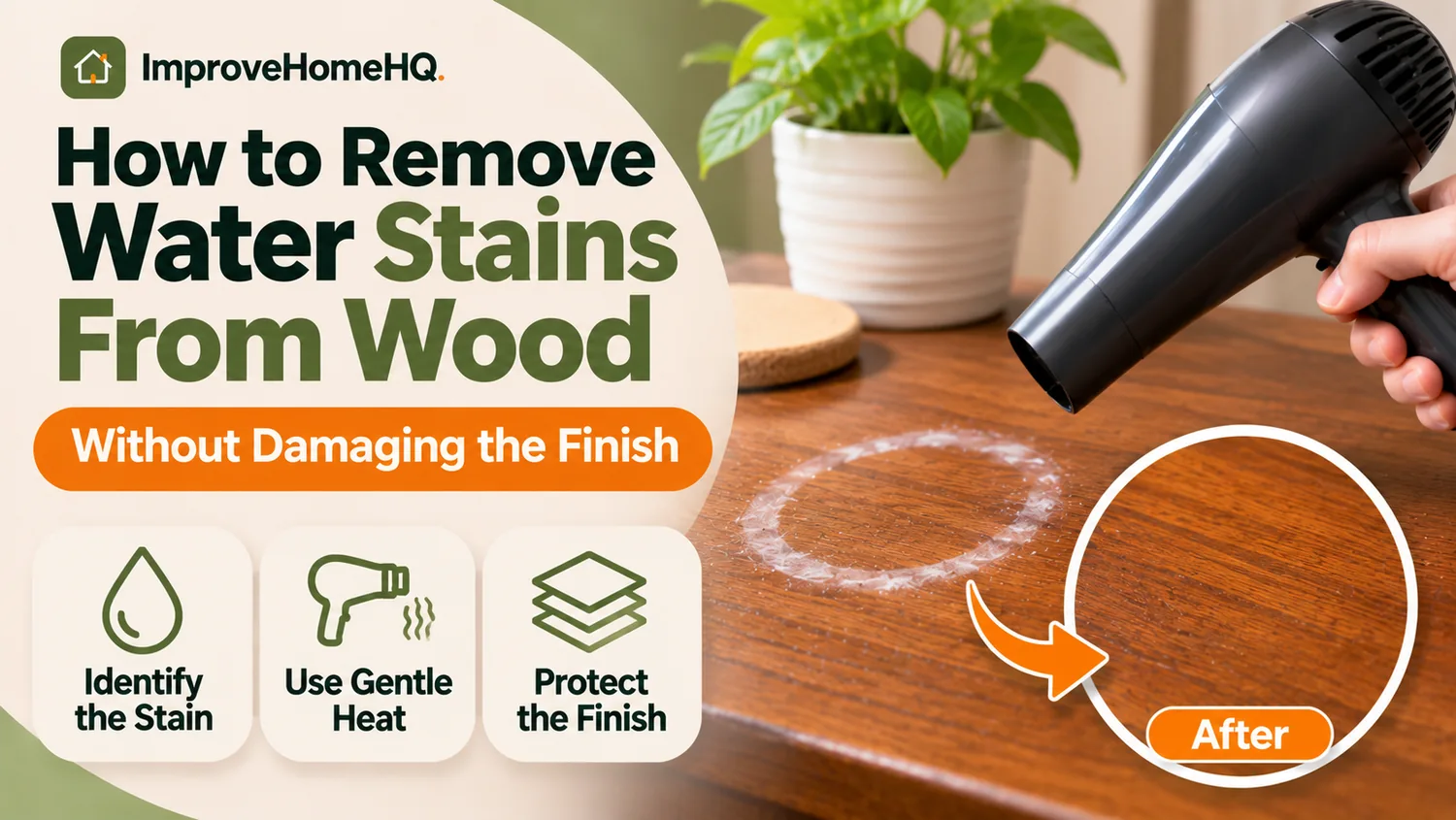
2. Try a Hair Dryer on Low Heat
Gentle moving air can sometimes help a moisture-related white ring fade. The danger is overheating the finish, not merely heating the wood.
- Test the dryer briefly on a hidden finished area.
- Select low heat and keep the nozzle several inches away.
- Move the airflow continuously across and beyond the mark; don’t concentrate it on one spot.
- Check after short intervals. Stop if the surface feels hot, changes sheen, softens, or becomes tacky.
- Let it return to room temperature before deciding whether the stain has improved.
Best for: Small white rings on sound, fully cured finishes that tolerate mild warmth.
Avoid on: Antique or delicate pieces, waxed surfaces, lifting veneer, cracked finishes, and anything with an unknown or heat-sensitive coating. Never use a heat gun; it is far too aggressive for this job.
3. Consider Petroleum Jelly for a Stubborn White Ring
Petroleum jelly is a traditional furniture-care remedy, but the evidence for it is mainly practical and anecdotal. It can temporarily alter the appearance of an affected finish and may leave an oily residue. It does not remove discoloration that has penetrated into the wood.
- Test a tiny amount in an inconspicuous spot and wait to check for dulling or discoloration.
- If compatible, apply a very thin film to the white mark.
- Leave it for a short trial period, then wipe it away completely with a clean cloth.
- Inspect after the surface has rested. Do not keep reapplying if nothing changes.
Best for: An inexpensive, conventionally finished piece when the owner accepts some risk of oily residue.
Avoid on: Raw or unfinished wood, open-grain surfaces, unfinished veneer, upholstery-adjacent wood, and museum-quality or antique furniture. Oils can penetrate unsealed wood and create another stain.
What About the Iron-and-Towel Method?
You may have seen advice to place a cloth over a white ring and pass an iron over it. In some cases, controlled warmth can improve cloudy moisture marks. But an iron can also melt, imprint, blister, or discolor a finish, particularly when its composition is unknown.
For that reason, an iron is not the first method we recommend. If the furniture manufacturer or a qualified refinisher approves it for the specific finish, follow their instructions exactly, use no steam, and check constantly. Otherwise, choose natural drying or low moving air instead. Never put an iron directly on wood.
How to Deal With Dark Water Stains in Wood
A dark stain is more than a cloudy coating. Water may have passed through a worn finish or an unsealed joint, leaving discoloration in the wood fibers. The black color can also result from iron reacting with tannins in species such as oak. No surface polishing trick can reliably pull that stain out.
Step 1: Stop the Moisture Source
Check for leaks, condensation, damp plant containers, or a spill that repeatedly reaches the same area. Allow the wood to dry thoroughly before repair. If it feels soft, swells, smells musty, or has distorted veneer, fix the moisture problem and evaluate the damage first.
Step 2: Determine Whether the Finish Must Come Off
On a sealed tabletop, bleach cannot reliably treat stained fibers through an intact polyurethane, lacquer, shellac, or varnish film. The affected finish generally needs removal before a wood treatment can reach the mark.
For solid wood, careful local refinishing may be possible, although matching the surrounding color and sheen can be difficult. On wood veneer, sanding or stripping too aggressively may expose the substrate. When in doubt, seek a refinisher’s assessment.
Step 3: Use Oxalic Acid Wood Bleach Only When Appropriate
Oxalic acid is used in wood restoration to reduce certain dark water and iron-related stains. It isn’t a universal cure: it won’t repair rotten fibers, failed adhesive, delaminated veneer, or every kind of discoloration.
According to coating manufacturer Rust-Oleum’s wood-bleaching guide, oxalic acid is intended for dark stains associated with water damage or rust, while other types of wood bleach serve different purposes.
For a refinishable piece:
- Choose a wood-bleaching product specifically labeled for the job. Read its full instructions and safety data sheet.
- Remove the existing coating from the intended treatment area using a process compatible with that finish and wood species.
- Test the treatment on a hidden or spare piece of matching wood if possible.
- Wear the chemical-resistant gloves, eye protection, and other protective equipment required by the product. Work in the ventilation conditions specified on the label.
- Apply, wait, rinse or neutralize if directed, and dry strictly according to that product’s directions. Do not improvise a concentration or combine cleaners.
- Inspect the dried result before deciding whether another labeled application or a full refinishing job is warranted.
Important: Oxalic acid is hazardous if mishandled. Keep it away from children and pets. Never mix it with household bleach, ammonia, or other cleaning chemicals. If the finish must be removed with a solvent or stripper, follow that product’s separate precautions as well.
Step 4: Match the Color and Refinish
Once the wood is clean and fully dry, the repaired spot may look lighter than the surrounding surface. Use a compatible wood stain or toner only if needed, followed by the appropriate clear coat. Test the entire color-and-finish combination first.
For a prominent dining table or floor, refinishing the whole tabletop or a complete flooring section may produce a more even result than spot-patching one circle. A professional can advise whether a repair is feasible without changing the appearance of the piece.
Do Home Remedies Like Vinegar, Baking Soda, and Toothpaste Work?
Some commonly suggested fixes can make a ring look better, but none is universally safe. Match the treatment to the material rather than reaching for whatever is in the pantry.
| Remedy | Potential benefit | Main concern | Our recommendation |
|---|---|---|---|
| White vinegar | May help with some surface deposits | Acid can affect certain coatings and exposed wood | Don’t use routinely on an unidentified finish |
| Baking soda paste | Mild abrasion may reduce some surface marks | Can scratch or dull gloss; adds moisture | Avoid on polished, satin, or delicate finishes |
| Non-gel toothpaste | Abrasives may polish a small mark | Can leave scratches or uneven sheen | Not a first-line treatment |
| Mayonnaise | Oils may temporarily change the appearance of a white ring | Greasy residue and possible oil staining | Skip on unfinished or porous wood |
| Olive oil | May temporarily conceal dull areas | Doesn’t fix deep stains; may leave residue | Use only if recommended for the finish |
| Mineral spirits | Can remove some waxy or oily residues | May damage or alter some finishes; flammable | Use only when finish compatibility is known |
| Steel wool | Can abrade surface finishes | Scratches and trapped metal particles can create dark marks | Avoid as a general stain-removal shortcut |
Never combine several home remedies at once. In particular, avoid acetone, nail polish remover, undiluted solvents, steam cleaners, and aggressive scrubbing on finished furniture. A cloudy white ring is often a minor problem; stripping off the finish accidentally is not.
Special Cases: Tables, Floors, Veneer, and Unfinished Wood
Finished Tables and Cabinets
Most drink rings occur on a tabletop’s clear topcoat. Start with drying, inspect for a white haze versus a dark stain, and proceed gently. Avoid soaking joints, carved edges, and seams. A finish that becomes cloudy after every damp glass may be worn or poorly suited to that location and could need recoating.
Hardwood Floors
A water mark on a polyurethane-coated hardwood floor isn’t necessarily the same as a ring on lacquered furniture. Wipe spills promptly and follow the flooring manufacturer’s cleaning instructions. Don’t use an iron, mayonnaise, vinegar mixture, or an abrasive paste across the boards. Black marks between planks, cupping, or persistent dampness may indicate a moisture problem below the visible surface.
Engineered wood flooring has a limited wear layer that may not tolerate sanding. If the boards are dark, buckled, or repeatedly wet, contact the floor manufacturer or a qualified flooring contractor before attempting repairs.
Veneered Furniture
A veneer is a thin layer of real wood bonded to a base material. Its thickness limits how much material can safely be removed. Keep liquids and heat away from seams and any lifted edges. A stain accompanied by a bubble or ridge may indicate adhesive failure, which stain remover cannot fix.
Unfinished or Raw Wood
Raw wood can absorb liquids and oils directly, so common greasy remedies are a poor choice. Let the wood dry first. A shallow surface mark may be improved with careful sanding in the direction of the grain, but this removes wood and can create a visible low spot. Deep discoloration may require controlled bleaching and an even finishing plan.
Antiques and Valuable Pieces
Older coatings, original patina, decorative veneer, and existing repairs can react unpredictably to heat or household products. Don’t experiment with irons, solvents, or bleach on furniture with financial, historical, or sentimental value. Consult a conservator or qualified furniture-restoration professional.
Common Mistakes That Make Water Marks Worse
- Treating every stain as a white ring. Dark wood discoloration often requires a different repair.
- Applying more heat when nothing is changing. High temperatures can soften or blister finishes.
- Scrubbing with abrasives. Toothpaste, baking soda, and steel wool can replace a ring with permanent scratches.
- Adding water to remove water damage. Wet pastes and cloths can prolong the problem, especially at open joints.
- Sanding through veneer. Once the thin facing is gone, the repair becomes much harder.
- Bleaching through a finish. An intact coating can block the treatment from reaching stained fibers.
- Ignoring recurring moisture. A leak or wet plant pot will create another mark even after a successful cosmetic repair.
How to Prevent Water Rings and Dark Spots
You don’t need to keep wooden surfaces completely untouched. A few habits greatly reduce staining:
- Use coasters under cold drinks and trivets under hot containers.
- Put waterproof saucers or barriers beneath houseplants; empty standing water promptly.
- Wipe up spills immediately, especially around table leaves, floorboard joints, and exposed edges.
- Use placemats that won’t trap moisture against the finish for long periods.
- Maintain the surface according to the furniture or floor manufacturer’s directions, rather than polishing on a fixed schedule.
- Investigate condensation, window leaks, plumbing leaks, and unusually damp rooms before they damage wood repeatedly.
For a heavily used table, the long-term solution may be repairing or replacing a failed protective finish—not repeating a home remedy each time a glass leaves a ring.
Frequently Asked Questions
Can water stains on wood be permanent?
Yes. A white ring sometimes fades as the finish dries, but some damaged coatings need repair. Dark stains that have penetrated the wood may require bleaching, sanding, or refinishing; severely damaged wood may not be fully restorable.
How do you remove white rings from a wooden table?
First blot away moisture and let the finish dry. If the ring remains and the coating is sound, test gentle moving air from a hair dryer on low heat. Stop at any sign of softening or sheen change. Don’t sand a white ring before checking whether the finish can recover.
Can you remove old water stains from wood?
Sometimes. Age alone doesn’t determine the solution. An old white mark may still be limited to the finish, while a recent dark stain may already have penetrated the wood. Diagnose its color and condition before choosing a method.
Will vinegar remove dark water stains?
Vinegar is not a reliable treatment for dark discoloration within wood fibers. It may also affect sensitive finishes. Deep stains often require a restoration product such as oxalic acid after the finish is removed, followed by refinishing.
Can I use an iron to remove a water ring?
Heat sometimes improves a white, moisture-related haze, but an iron can damage clear coatings or veneer. It is not appropriate for an unidentified finish. Try natural drying first and avoid direct contact between a hot iron and wood.
Does mayonnaise really remove water rings?
It may temporarily reduce the appearance of certain white marks, but results vary and the oil can stain exposed wood. It won’t remove a dark stain inside the wood. A small, hidden test is essential if you decide to try an oily treatment.
Why does my wood turn black when it gets wet?
Water can enter through worn finishes or exposed edges and cause discoloration in the wood. In some species, particularly tannin-rich woods, reactions involving iron can create a dark gray or black mark. Ongoing moisture can also contribute to deterioration and biological staining.
Should I sand a water stain out?
Not as a first step. Sanding a white ring can destroy a repairable finish. With a dark stain, refinishing may be necessary, but veneer and engineered flooring have limited sanding tolerance. Determine the surface construction before removing material.
The Bottom Line
The safest approach is to match the fix to the stain. A white, cloudy ring usually calls for patience and gentle finish-level care. A dark patch points to moisture that may have reached the wood and can require proper restoration. If you don’t know the finish—or the piece is valuable—stop before using heat, abrasives, or chemicals. Preserving an intact surface is better than turning a small mark into a major refinishing project.